

TL;DR:
- Type B waterproofing relies on water-resistant concrete and precise joint detailing to create an integral water barrier. It is mainly suitable for new structures and must be paired with other systems for high-risk spaces, with success dependent on expert design and execution. Proper joint treatment and specialist oversight are essential to prevent failures and ensure long-term watertightness.
Type B waterproofing is defined as structurally integral protection where the building’s concrete structure itself forms the watertight barrier against water ingress. Unlike applied membranes, this approach relies on water-resistant concrete combined with precisely detailed construction joints to prevent moisture penetration. Governed by BS 8102:2022, it is the standard most relevant to below-ground structures such as basements, retaining walls, and underground car parks. Understanding how it works, where it fits, and what can go wrong is the difference between a dry basement and a costly failure.
What is type b waterproofing and how does it work?
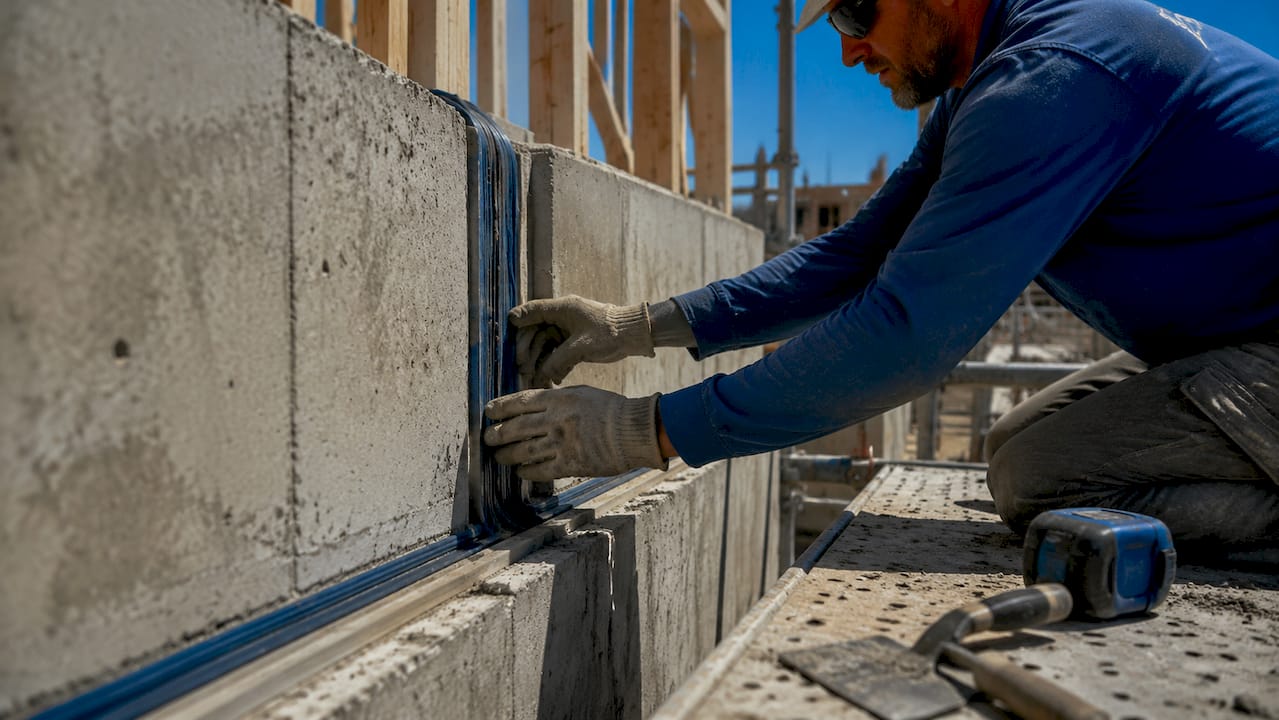
Type B protection relies on water-resistant concrete combined with hydrophilic waterstops at construction joints to prevent water ingress. The concrete itself is the barrier. There is no applied membrane doing the heavy lifting. Every element of the structure, from the mix design to the pour sequence, contributes to the watertight result.
Construction joints are the critical points in any Type B system. These are the interfaces between separate concrete pours, and they represent the most vulnerable locations for water to find a path through. Hydrophilic waterstops, which expand on contact with water, are embedded at these joints to seal them permanently. Without correct placement and timing, the entire system is compromised.
This approach is most commonly used in new-build basements, underground structures, and large civil engineering projects. It is less about products and more about process. That distinction matters enormously when you are briefing a contractor or reviewing a specification.
How does type b compare with type a and type c systems?
The three waterproofing types under BS 8102:2022 each take a fundamentally different approach to keeping water out. Understanding the distinctions helps you ask the right questions of your design team.
Type A waterproofing uses applied barrier membranes, either bonded to the external face of the structure or applied internally as a cementitious coating. It does not rely on the concrete being watertight. Type C uses a drained cavity system, where water that does penetrate the structure is collected and managed rather than stopped at the wall. Type B sits between these two philosophies: the structure itself is the barrier, with no reliance on drainage or applied coatings.
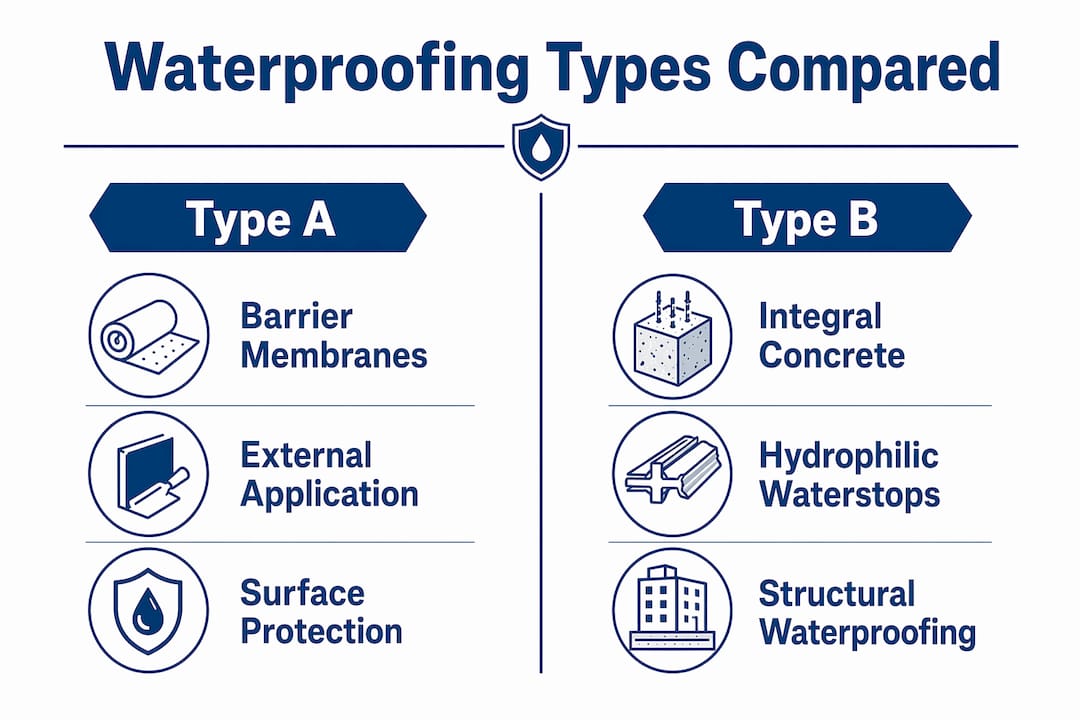
| System | Mechanism | Best Use | Key Limitation |
|---|---|---|---|
| Type A | Applied barrier membrane | Existing structures, retrofits | Membrane damage is hard to locate and repair |
| Type B | Integral watertight concrete | New builds, major structural works | Requires high construction discipline at joints |
| Type C | Drained cavity system | High water table, retrofit basements | Does not stop water, only manages it |
Each system has a legitimate place in practice. The choice is not about which is best in isolation. System selection is governed by project risk assessment and intended use, not just the grade requirement. For Grade 3 spaces such as habitable rooms, a single Type B system is rarely sufficient on its own. A combined approach, pairing Type B with Type A or Type C, is the standard recommendation for higher-risk applications.
Pro Tip: Never accept a specification that proposes Type B alone for a habitable basement without seeing a written risk assessment. Ask your designer to confirm the performance grade and justify the system choice against it.
What materials and techniques make type b waterproofing reliable?
The materials in a Type B system are straightforward. The execution is not. Water-resistant concrete typically incorporates admixtures such as crystalline waterproofing agents or plasticisers that reduce permeability. Brands such as Xypex and Kryton produce crystalline admixtures widely used in Type B applications. These products cause crystals to form within the concrete matrix, blocking capillary pathways through which water would otherwise travel.
The real challenge lies at the joints. Joint design, timing of concrete pours, and waterstop placement are critical for Type B reliability. A waterstop placed incorrectly, or a pour made before the previous lift has cured adequately, creates a permanent weak point. No membrane can be applied later to fix an integral failure.
Key materials and techniques for a reliable Type B system include:
- Water-resistant concrete mix: Specify a minimum water-to-cement ratio of 0.45 or lower, with appropriate admixtures for the site conditions.
- Hydrophilic waterstops: Embedded at every construction joint, these must be positioned centrally within the joint and protected from premature wetting before the pour.
- Injection hoses: Placed at joints as a secondary measure, allowing post-construction grouting if any seepage is detected.
- Pour sequencing plan: A written programme for the order and timing of concrete pours, reviewed and approved before work begins.
- Curing regime: Adequate curing time between pours prevents shrinkage cracking, which is a separate but equally damaging failure mode.
Pro Tip: Require the contractor to submit a joint detailing drawing and a pour sequence programme before any concrete is placed. If they cannot produce these documents, they are not equipped to deliver a Type B system.
How does BS 8102:2022 shape type b waterproofing design?
BS 8102:2022 is the British Standard that governs the design of below-ground structures against water ingress. It replaced the 2009 edition and introduced significant changes to how waterproofing systems are specified and assessed. Property owners commissioning basement works in the UK need to understand its basic framework, even if the technical detail sits with their design team.
The standard defines four performance grades, from Grade 1a (car parking, plant rooms) through to Grade 4 (archives, swimming pools). These grades describe the acceptable level of water ingress for a given use. Crucially, performance grades do not dictate which system type to use. They define the outcome. How you achieve that outcome is a separate design decision, informed by a risk assessment.
The 2022 revision placed greater emphasis on combined protection for higher-grade spaces. Grade 3 and above spaces usually require combined protection rather than single Type B only. This means a basement intended as a bedroom or office will almost certainly need Type B paired with either a Type A membrane or a Type C cavity drain system. The standard also formalised the role of the waterproofing specialist, distinct from the structural engineer.
Key design requirements under BS 8102:2022 for Type B systems:
- A written risk assessment identifying groundwater level, soil type, and structural form.
- System selection justified against the performance grade for the intended use.
- Detailing of all construction joints, penetrations, and interfaces.
- A named waterproofing specialist responsible for the design.
- A maintenance and inspection plan for the completed structure.
Waterproofing design including system selection, drainage, grading, and interfaces often falls outside a structural engineer’s scope. This is not a criticism of structural engineers. It is a scope boundary that many projects fail to recognise, leading to gaps in the specification that only become apparent when water appears.
Pro Tip: Ask your project team directly: “Who is the named waterproofing specialist on this project?” If the answer is the structural engineer, push back. The two roles are distinct under BS 8102:2022.
Is type b waterproofing suitable for renovations and retrofits?
Type B waterproofing is best suited for new builds or major structural repairs where integral concrete construction can be applied effectively. This is a hard constraint, not a preference. Existing basements often cannot incorporate Type B effectively due to access and construction constraints. If you are converting an existing basement or dealing with a damp wall in a Victorian terrace, Type B is almost certainly not the right tool.
For new builds, Type B offers a genuine advantage: the waterproofing is built into the structure rather than applied to it. There is no membrane to delaminate, no drainage channel to block, and no reliance on a secondary system for day-to-day performance. The structure is the solution.
For renovation projects, the realistic options are:
- Type A applied membranes: Cementitious coatings or liquid waterproofing membranes applied to existing walls and floors.
- Type C cavity drain systems: Installed against existing walls to collect and redirect water to a sump pump.
- Combined Type A and C: The most common approach for existing basements with active water ingress.
The appointment of a Certified Surveyor in Structural Waterproofing (CSSW) is the single most important step for any basement project, new build or retrofit. A CSSW holds a qualification recognised by the Property Care Association and is trained to assess risk, specify systems, and review contractor proposals. Formal waterproofing specialist involvement significantly reduces the risk of specification and construction errors that cause waterproofing failures.
| Project Type | Type B Feasibility | Recommended Approach |
|---|---|---|
| New build basement | High | Type B as primary, combined with Type A or C for Grade 3+ |
| Major structural repair | Moderate | Type B at repaired sections, combined system overall |
| Existing basement conversion | Low | Type A or Type C, or combined |
| Retrofit damp proofing | Not suitable | Type A cementitious or Type C cavity drain |
What errors most often cause type b waterproofing to fail?
The most common cause of Type B failure is poor joint execution. Construction joint detailing and execution quality are the make-or-break factors for Type B success rather than just concrete mix. A contractor who focuses on achieving the right concrete specification but neglects joint detailing will produce a leaking structure regardless of the mix design.
The second most common error is overconfidence in the concrete mix. Water-resistant concrete is not waterproof concrete. Even the best admixture cannot compensate for a poorly executed joint or a crack caused by inadequate curing. The mix is a necessary condition, not a sufficient one.
Other frequent failure points include:
- Premature wetting of waterstops: Hydrophilic waterstops that expand before the second pour is placed cannot seal the joint correctly.
- Omitting injection hoses: Without a secondary grouting option, any seepage at joints has no remediation route short of structural exposure.
- Ignoring drainage integration: Even a well-executed Type B system benefits from perimeter drainage to reduce hydrostatic pressure on the structure.
- No specialist oversight: Projects where the structural engineer doubles as the waterproofing designer frequently miss critical interface details.
Pro Tip: Commission an independent inspection of all construction joints before the second concrete pour. A CSSW or specialist waterproofing consultant can review joint preparation and waterstop placement at a fraction of the cost of remediation.
Key takeaways
Type B waterproofing succeeds or fails at the construction joint, making specialist design and rigorous site execution non-negotiable for any below-ground structure.
| Point | Details |
|---|---|
| Structural integrity is the barrier | Type B relies on watertight concrete and detailed joints, not applied membranes. |
| BS 8102:2022 governs system selection | Performance grades define outcomes; risk assessment determines which system type to use. |
| Joints are the critical failure point | Waterstop placement, pour timing, and joint preparation determine long-term reliability. |
| New builds only for Type B | Existing basements cannot practically incorporate Type B without major structural works. |
| Combined systems for Grade 3 and above | Habitable basement spaces require Type B paired with Type A or Type C for compliance. |
Why i think type b is misunderstood more than any other system
Most property owners I speak with assume Type B waterproofing means “good concrete.” It does not. It means a precisely engineered construction process where the concrete, the joints, the waterstops, and the pour sequence all work together as a single system. The concrete mix is almost the least important variable.
The misunderstanding creates real problems on site. Contractors who understand concrete but not waterproofing will produce a structure that looks right and performs poorly. I have seen projects where the concrete specification was exemplary and the basement still leaked within two years, because nobody had detailed the construction joints or specified waterstops correctly.
My strongest advice to any property owner commissioning a new basement is this: appoint a CSSW before you appoint a contractor. The specialist’s fee is modest relative to the project cost. The cost of remediation, which can involve breaking out finished floors and walls, is not. For basement waterproofing solutions that combine Type B with other systems, the specialist’s role becomes even more critical, because the interfaces between systems are where failures concentrate.
Type B paired with a Type C cavity drain is, in my experience, the most resilient combination for a new-build basement in a high water table location. The integral concrete handles the bulk of the load. The cavity drain manages any residual seepage without allowing pressure to build. Neither system alone is as reliable as both together. That is the logic of combined waterproofing protection that BS 8102:2022 formalised, and it reflects how the best projects are actually built.
— Eben
How Prowaterproofing can support your waterproofing project
Prowaterproofing works with property owners and managers across South Africa to design and install waterproofing systems that meet the demands of below-ground structures. Whether you are planning a new basement or assessing an existing structure, the team at Prowaterproofing can provide a tailored assessment aligned with BS 8102:2022 principles and local site conditions.
From integral concrete systems through to combined Type A and Type C solutions, Prowaterproofing brings specialist knowledge to every stage of the project. The team understands that selecting the right contractor is as important as selecting the right system. Contact Prowaterproofing today for a consultation and get a clear picture of what your project actually needs before any work begins.
FAQ
What is type b waterproofing in simple terms?
Type B waterproofing uses the building’s concrete structure as the water barrier, relying on water-resistant concrete and sealed construction joints rather than applied membranes. It is governed by BS 8102:2022 and is most effective in new-build below-ground structures.
Can type b waterproofing be used in an existing basement?
Type B is generally unsuitable for existing basements because it requires integral concrete construction that cannot be retrofitted without major structural exposure. Existing basements are better served by Type A membranes or Type C cavity drain systems.
Does type b waterproofing meet BS 8102:2022 on its own?
For Grade 1a and Grade 2 spaces, Type B alone may be sufficient with a proper risk assessment. For Grade 3 habitable spaces and above, BS 8102:2022 recommends combined protection, pairing Type B with Type A or Type C systems.
What is the most common cause of type b waterproofing failure?
Poor construction joint execution is the leading cause of failure, specifically incorrect waterstop placement and inadequate pour sequencing. No membrane can be applied internally to repair an integral joint failure after the fact.
Do i need a specialist to design a type b waterproofing system?
A Certified Surveyor in Structural Waterproofing (CSSW) should be appointed for any Type B project. Waterproofing design falls outside a structural engineer’s standard scope, and a specialist reduces the risk of critical gaps in the specification.