

TL;DR:
- Waterproofing defect liability is the builder’s obligation to repair membrane failures during a specified period after construction. The typical defect liability period lasts 6 to 24 months from practical completion and covers major defects that can threaten structural integrity for up to 10 years. Property owners should document the membrane installation carefully and act promptly when defects are discovered to protect their legal rights.
A waterproofing defect liability is the contractual and legal obligation of a builder or contractor to repair failures in waterproofing systems within a designated period after construction is complete. This obligation sits at the heart of most building contracts and statutory warranty frameworks, and understanding it determines whether you can enforce repairs at no cost or face the bill yourself. The industry term for the contractual window is the Defect Liability Period (DLP), which typically runs for 6–24 months from practical completion. Waterproofing defects are classified as either major or minor, with major defects carrying statutory warranties of 6–10 years in many jurisdictions. Knowing the difference between these categories, and acting within the correct timeframe, is the single most important thing you can do to protect your property.
What is a waterproofing defect liability and how is it defined?
A waterproofing defect is the failure of a membrane or system to prevent water penetration as required by the applicable building code or contract specification. This is legally and technically distinct from water ingress. Water ingress is the symptom. The defect is the cause.
Common examples of waterproofing defects include:
- Membrane damage or puncture during construction, often caused by following trades working over uncured membranes
- Poor detailing at junctions, such as where a floor membrane meets a wall upstand or a pipe penetration
- Insufficient membrane thickness, where the applied product does not meet the minimum specified by standards such as AS 3740-2021
- Incompatible materials, where a primer, membrane, and tile adhesive are not specified to work together
- Premature tiling, where tiles are fixed before the membrane has fully cured, breaking the bond
Defects are classified as major or minor. A major defect affects the structural integrity of the building or makes it uninhabitable. Waterproofing failures are regarded as major defects in most jurisdictions because water ingress causes structural damage over time. Minor defects are cosmetic or functional issues that do not threaten the building’s integrity.
Pro Tip: Take dated photographs of every waterproofing membrane before tiles or screeds are laid. This single step is the most powerful evidence you can hold if a defect claim arises later.
How long is the waterproofing defect liability period?
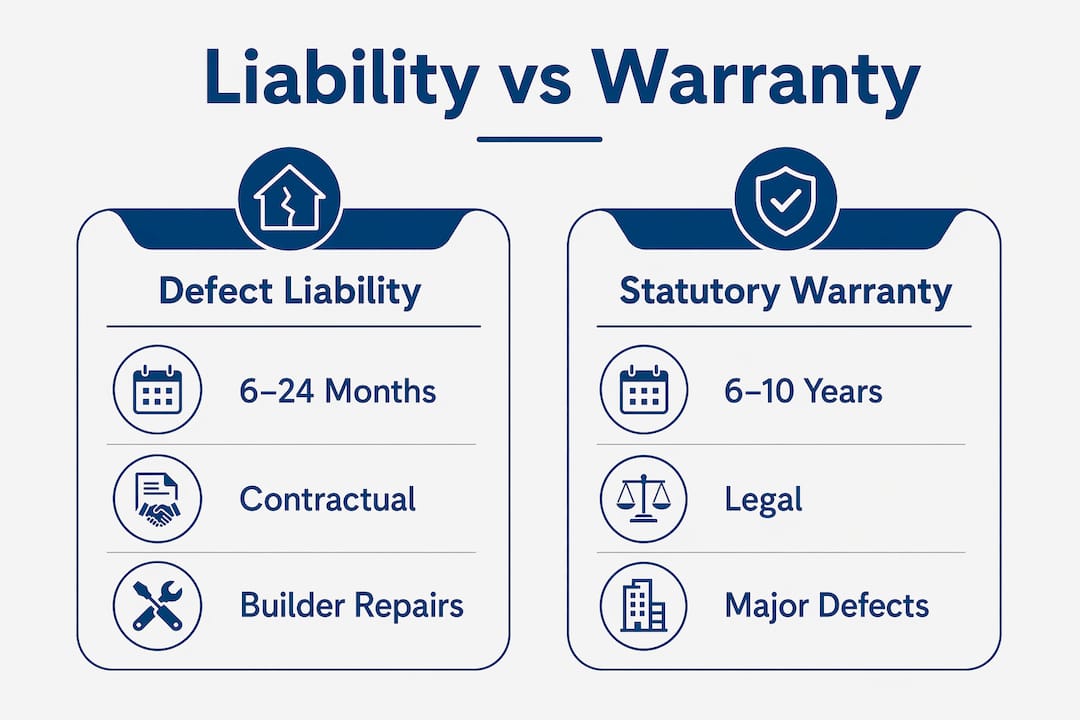
The Defect Liability Period is the contractual window during which a builder must return and fix defects at no charge to you. The DLP typically lasts 6–24 months, with 12 months being the most common term in residential contracts. The DLP begins at practical completion, which is the date the building is handed over and fit for occupation.

The DLP is separate from statutory warranties, which are set by legislation and cannot be contracted away. The table below summarises the key differences.
| Term | Duration | Scope | Enforced by |
|---|---|---|---|
| Defect Liability Period (DLP) | 6–24 months (typically 12) | All defects listed at handover or discovered during the period | Contract terms |
| Statutory warranty (minor defects) | 2 years from completion | Cosmetic and functional defects | Building legislation |
| Statutory warranty (major defects) | 6–10 years from completion | Structural and waterproofing failures | Building legislation |
The practical implication is significant. If you discover a waterproofing failure at month 18 after handover, your DLP may have expired. However, your statutory warranty for major defects almost certainly has not. You still have a legal claim. The clock on statutory warranties runs from practical completion, not from when you discover the problem. This means a defect hidden behind tiles for three years may still fall within the statutory window.
Waterproofing warranty issues become complicated when owners delay reporting. Notify your builder in writing as soon as you identify any sign of water ingress, damp patches, or efflorescence. Delay can be used to argue that the damage worsened due to owner inaction.
What rights and remedies do property owners have?
Property owners hold clear rights during and after the DLP. The most direct is the right to require the builder to rectify defects free of charge. If the builder refuses or fails to act within a reasonable time, you have several escalation options.
- Issue a formal written notice to the builder specifying the defect, the location, and a reasonable deadline for rectification. Keep a copy of every communication.
- Commission an independent expert report from a licensed waterproofing inspector or building consultant. This report documents the defect, its likely cause, and the cost of repair. It is the foundation of any formal claim.
- Lodge a complaint with the relevant building authority or tribunal in your jurisdiction. In South Africa, the National Home Builders Registration Council (NHBRC) provides a statutory warranty scheme for new homes. Disputes can be referred to the NHBRC or to civil court.
- Claim consequential damages if the defect has caused damage to interiors, flooring, ceilings, or personal property. Consequential damage claims are separate from the cost of rectifying the defect itself and can be substantial.
- Pursue latent defect claims for defects that were not discoverable at handover. Latent defect claims may extend up to 3 years after discovery, depending on your jurisdiction, even after the DLP has ended.
Pro Tip: Keep a dedicated folder, physical or digital, with your contract, handover certificate, all correspondence with the builder, inspection reports, and photographs. A well-organised file can resolve a dispute in weeks rather than years.
Engaging a specialist waterproofing contractor for an independent assessment before you approach the builder gives you a credible, costed position from the outset. It also signals to the builder that you are prepared to escalate.
What causes waterproofing defects and how is liability determined?
Waterproofing failures arise from system failures, not from product failures alone. The membrane itself is rarely the problem. The problem is how it was designed, specified, and installed.
The most common causes include:
- Design oversights, such as failing to specify a membrane at all in wet areas, or specifying a product unsuitable for the substrate
- Material incompatibility, where a contractor substitutes a specified product without checking compatibility with adjacent materials
- Poor workmanship at junctions, particularly where a floor meets a wall, where a pipe penetrates a slab, or where a balcony drain is detailed
- Rushed site sequencing, such as tiling over membranes too soon before the product has cured to specification
Liability is determined by identifying who was responsible for each element: design, specification, and installation. This is where many disputes become complicated.
Without a named independent expert responsible for waterproofing design, liability risks default to contractors or architects, creating significant responsibility gaps. Design-and-build contracts do not automatically transfer waterproofing risk, and the absence of a clear design responsibility allocation has resulted in claims exceeding £300,000 in a single basement project.
Insurance adds another layer of risk. General liability insurance often excludes faulty workmanship, and professional liability policies may hold contractors personally liable if they assumed design roles without the relevant qualifications. This means a contractor who specified a waterproofing system without being a qualified designer may find their insurer refuses to cover the claim.
For property owners, the practical lesson is to review your building contract before construction begins and confirm that waterproofing design responsibility is explicitly named. If it is not, request an amendment. A single clause can prevent years of dispute.
Photographic evidence taken before tiling is the definitive proof in waterproofing liability disputes. Without it, proving that a membrane was applied incorrectly, or not at all, becomes extremely difficult once finishes are in place.
Key takeaways
Waterproofing defect liability defines the builder’s obligation to repair membrane and system failures within a contractual DLP and statutory warranty period, with major defects covered for up to 10 years.
| Point | Details |
|---|---|
| Defect vs water ingress | A defect is the membrane failure; water ingress is the resulting symptom. Treat them as separate issues. |
| DLP duration | The Defect Liability Period runs 6–24 months from practical completion; 12 months is most common. |
| Statutory warranty | Major waterproofing defects carry statutory warranties of 6–10 years, independent of the DLP. |
| Owner’s first step | Issue written notice to the builder immediately upon discovering any defect, and commission an expert report. |
| Liability gaps | Contracts must name who is responsible for waterproofing design, or liability becomes shared and disputed. |
Why documentation is the real foundation of any defect claim
Property owners consistently underestimate how much a defect claim depends on evidence gathered before the problem becomes visible. By the time water stains appear on a ceiling or tiles begin to lift, the membrane is already buried under layers of screed and tile adhesive. At that point, proving what was or was not installed requires invasive investigation, expert testimony, and often significant legal cost.
The property owners I see navigate defect claims successfully share one habit: they treated the pre-tile inspection as non-negotiable. They were present when the membrane was applied, they photographed every junction and penetration, and they kept a dated record. When a dispute arose, they had a clear, visual timeline that no builder could contradict.
The other pattern I see is owners who discover a defect late, assume the DLP has expired, and write off the repair cost. That assumption is wrong in most cases. Statutory warranties for major defects run well beyond the DLP, and latent defect provisions extend further still. If you are unsure whether your claim is time-barred, get a legal opinion before you accept the cost yourself.
Contract clarity matters just as much as documentation. If your building contract does not name a specific party as responsible for waterproofing design, you are exposed to a liability gap that can take years and significant expense to resolve. Push for that clause before construction starts. It costs nothing to add and can save everything later.
— Eben
Prowaterproofing: professional support for defect liability periods
Waterproofing defect liability is not just a legal concept. It is a practical problem that requires professional assessment, clear documentation, and timely action.
Prowaterproofing provides specialist waterproofing inspection and rectification services for residential, commercial, and industrial properties across South Africa. Whether you are approaching a builder about a defect claim, preparing an independent expert report, or simply want a pre-tile inspection to protect your position, Prowaterproofing has the experience to support you. The team understands the timelines, the evidence requirements, and the standards that govern waterproofing defect liability claims. Visit prowaterproofing.co.za to request an assessment or consultation.
FAQ
What is a waterproofing defect liability period?
The waterproofing defect liability period is the contractual window, typically 6–24 months from practical completion, during which a builder must repair waterproofing defects at no cost to the property owner. It is separate from, and shorter than, statutory warranty periods.
How long does a waterproofing warranty last?
Statutory warranties for major waterproofing defects last 6–10 years from practical completion in most jurisdictions. Minor defects carry a shorter statutory warranty of approximately 2 years.
What causes most waterproofing defects?
Most waterproofing defects result from system failures in design or workmanship, not from the membrane product itself. Poor junction detailing, incompatible materials, and premature tiling are the most frequent causes.
Can I claim after the defect liability period ends?
Yes. Statutory warranties for major defects extend well beyond the DLP, and latent defect provisions may allow claims up to 3 years after discovery. Notify your builder in writing and seek an independent expert report as soon as a defect is identified.
What evidence do I need for a waterproofing defect claim?
Dated photographs of the membrane before tiling, a written defect notice to the builder, and an independent expert report are the three core pieces of evidence for any waterproofing liability claim. Without pre-tile photographs, proving the cause of a defect becomes significantly harder.