
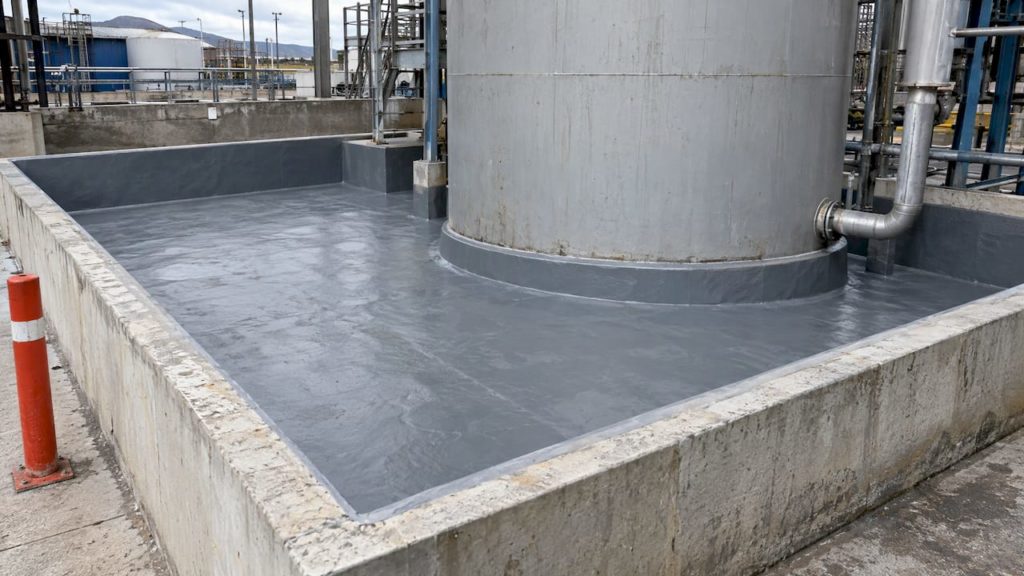
Industrial bund lining waterproofing is a chemical-resistant, liquid-tight barrier applied to the floor and walls of a bund, the contained area around tanks or drums that holds a spill if the primary vessel fails. The lining stops fuel, chemicals or contaminated water soaking into concrete and the ground beneath. In the Western Cape, it is also how a site shows that its containment meets South Africa’s waste-storage norms. If you own or manage an industrial building there, we connect you with vetted waterproofing professionals through a single quote request.
TL;DR
- A bund is a walled containment area around tanks or drums. Bund lining waterproofing makes its floor and walls impermeable and resistant to whatever is stored.
- A bund is not a dam, reservoir or tank. It sits empty until something goes wrong, so the lining must resist a sudden chemical spill, not constant water pressure.
- South Africa’s 2013 National Norms and Standards for waste storage call for impermeable, chemical-resistant floors and secondary containment of at least 110% of the maximum contents.
- Weekly leak inspections and an annual inspection of tanks and bunding by a registered engineer are required for these facilities.
- Joints, seams and pipe penetrations are where bunds usually fail, so the detail around them matters more than the headline product.
Table of Contents
- What a bund is and what the lining does
- How bund lining differs from lining a dam, reservoir or tank
- What a bund lining is made of
- How an industrial bund is prepared, lined and checked
- South African rules that apply in the Western Cape
- Inspecting and maintaining a bund lining
- Choosing who should do the work
- Getting a bund lining quoted
- Our perspective
- FAQ
- Sources
What a bund is and what the lining does
A bund is a bowl: a floor with a raised wall or kerb around it, built to hold the contents of the tanks, drums or process vessels inside it. Day to day it is dry and does nothing. Its whole value arrives on the day a tank splits, a valve fails or a hose is knocked off.
On that day, three things must be true. The bund must be big enough to hold the spilt liquid. The surface must not let that liquid through. And the surface must not be eaten away by the chemical it is holding.
Plain concrete does none of these reliably. It is porous, it cracks as it cures and moves, and many fuels, acids and solvents attack it. A bund lining is the layer added on top (or built into) the concrete or steel to fix this. It is a waterproofing job in the strict sense, but the “water” is whatever your site stores.
That is why a typical bund lining job differs from the waterproofing you might see on a roof or basement. Our guide to liquid waterproofing membranes for concrete covers the general product family. Bund work takes that logic and adds chemical resistance as the first requirement.
How bund lining differs from lining a dam, reservoir or tank
Search results for this topic are crowded with dam and reservoir lining pages, and the confusion is understandable: all of them are about keeping liquid where it belongs. The conditions are very different, though.
A reservoir or dam is full all the time. The lining sits under constant hydraulic pressure. Research on reservoir lining describes a multi-layer system in which at least one barrier layer, with very low hydraulic conductivity, limits seepage into the ground and embankment. The simplest version has three layers. Sika’s guidance on potable water reservoirs lists the main routes: rigid cementitious layers, flexible liquid-applied polymer-modified mortars or reactive resins with joint sealing, or loose-laid sheet membranes. The choice depends on local requirements and water quality.
A bund is empty most of the time. It is loaded only in an emergency, and then with something much nastier than water. So the design questions change:
| Question | Dam or reservoir | Industrial bund |
|---|---|---|
| How often is it loaded? | Constantly | Rarely, but without warning |
| What does it hold? | Water | Fuel, oil, acids, alkalis, solvents, process liquids |
| Main threat to the lining | Pressure, UV, movement | Chemical attack, impact, fire, cracking |
| Typical priority | Seepage control | Immediate, total containment of a spill |
| Who checks it? | Dam or reservoir owner | Site owner, plus a registered engineer for regulated storage |
In short, a reservoir lining is judged on how little water gets through over months. A bund lining is judged on how it behaves on the worst day of the site’s year.
What a bund lining is made of
The right material depends on the substrate (concrete or steel), what is stored, the temperatures involved and how much movement the structure sees. In broad terms, South African bund work uses a few families of system:
- Chemical-resistant coatings and resin systems. Epoxy, polyurethane and similar coatings are applied to prepared concrete or steel to form a seamless surface. They suit bund floors and lower walls where the chemical is known.
- Flexible liquid-applied membranes. These bridge small cracks and movement, which matters in large concrete bunds that expand and contract. For general background on how these work on concrete, see our guide to liquid waterproofing membranes for concrete.
- Reinforced systems. A fabric or mesh embedded in the membrane adds strength where there is movement, at corners and over joints. We explain this in the role of reinforcement mat in waterproofing.
- Welded sheet liners (geomembranes). Sheets such as HDPE are welded at the seams to form a continuous liner, often for large earth or lagoon-style containment.
- Cementitious coatings. Useful for sealing concrete against water, but their role in chemical containment is limited by what the stored product does to cement. Our overview of cementitious waterproofing for South African properties explains where they fit.
No single product is best. Our broader overview of waterproofing materials makes the same point: the job decides the material.
Chemical compatibility comes first
The most common specification mistake is choosing a lining for its waterproofing performance and checking the chemistry afterwards. Work in the other order:
- List every substance that could reach the bund: the stored product, but also cleaning agents, firefighting water and rainwater mixed with residues.
- Note concentrations and temperatures, not just names. A coating that tolerates a dilute acid may fail under the concentrated one.
- Ask the system supplier for chemical resistance data covering those exact substances, in writing.
- Match the lining to the worst credible case, not the usual one.
Rainwater is a quiet factor. Open bunds fill with it, and it must be drained or removed in a controlled way, never straight to stormwater if it may be contaminated.
How an industrial bund is prepared, lined and checked
The quality of a bund lining is mostly decided before any coating is applied. Here is the sequence, and where it tends to go wrong.
1. Assess the substrate
Concrete is checked for strength, moisture, contamination (oil-soaked concrete will not bond), cracks and laitance, the weak surface layer. Steel is checked for corrosion. Skipping this step is the leading reason linings blister or peel.
2. Prepare the surface
The surface is cleaned and mechanically prepared, typically by grinding or blasting, to give the lining something to grip. Cracks are routed and filled, and the wall-to-floor junction is formed into a proper detail rather than a sharp internal corner.
3. Deal with penetrations and joints
Pipes, drains and sumps through a bund floor are the weak points. A risk engineering position paper on atmospheric storage tanks says floor penetrations are major leak risks: new designs should avoid them, and existing ones should be sealed with fire-resistant materials or otherwise remediated. The same paper notes that concrete bund joints are particularly susceptible to fire and cooling, and that fire-resistant sealants help keep them intact.
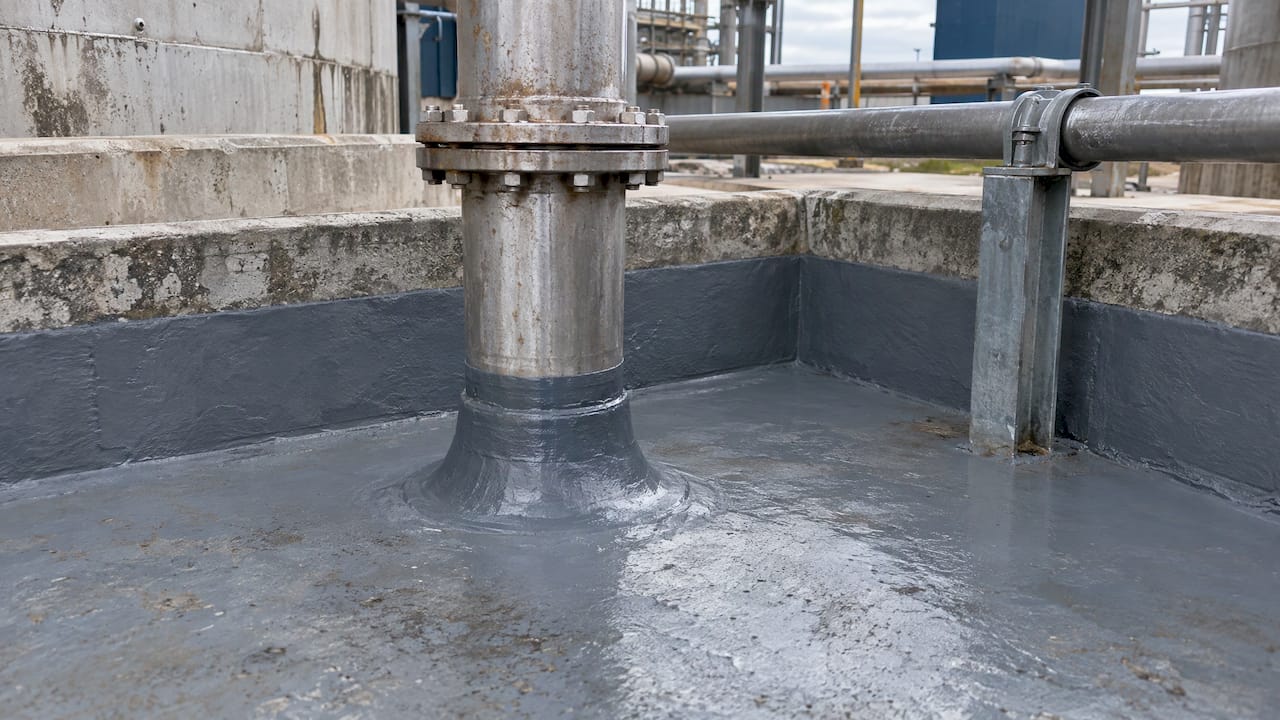
If you are building or refurbishing, the best penetration is the one that is not there. Where it cannot be avoided, it needs a purpose-made detail.
4. Apply the lining
Coatings are applied in controlled thicknesses and coats, within the temperature and humidity limits the manufacturer sets. Reinforcement goes in at joints and corners. Sheet liners are welded and the welds tested.
On seam testing, US EPA inspection guidance describes destructive peel and shear tests, which verify the tensile strength of geomembrane welds and are performed at a specified frequency during installation. For a sheet-lined bund, ask what weld testing will be done and how often.
5. Cure, test and record
The lining must fully cure before it meets chemicals. Then it is inspected for pinholes, thin spots and gaps, and the results are recorded. Keep that record. It is the first thing a regulator, insurer or auditor will ask for.
South African rules that apply in the Western Cape
Bund lining is not a free choice of the site owner. The following rules shape what you must build and maintain.
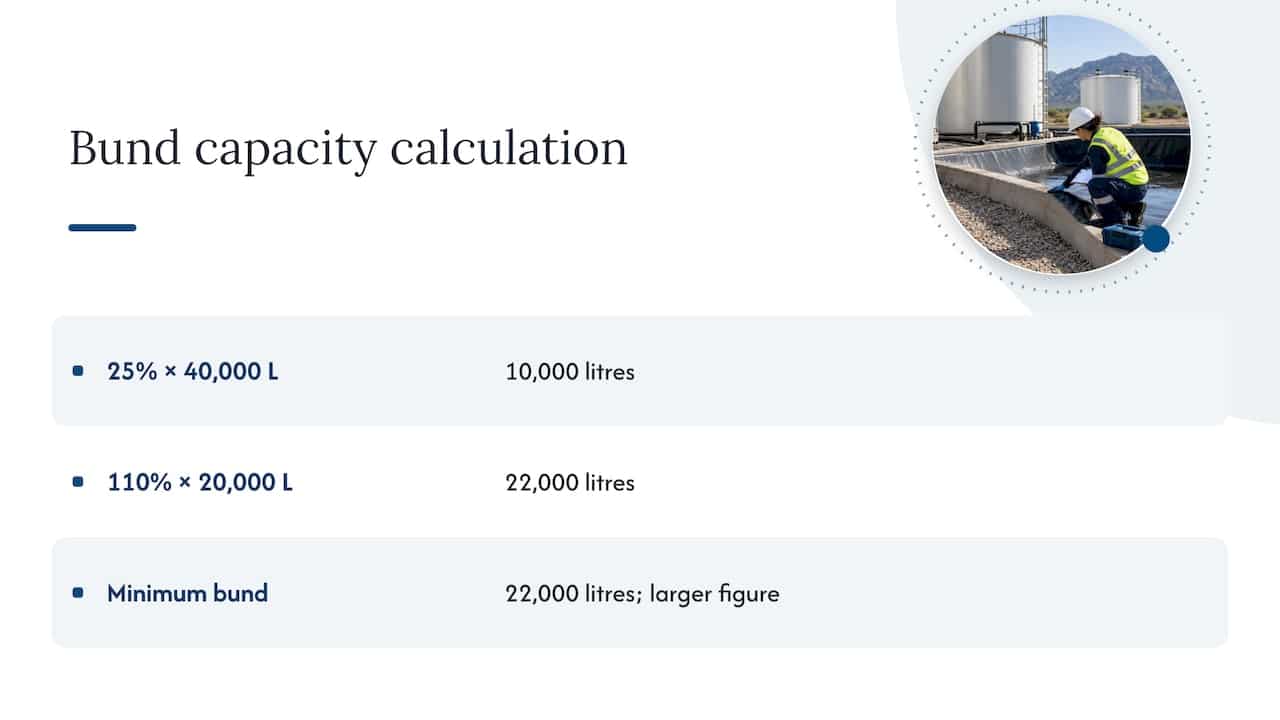
Floors and capacity. South Africa’s 2013 National Norms and Standards for the storage of waste require hazardous waste storage facilities to have impermeable, chemical-resistant floors. Liquid-waste areas need secondary containment of at least 110% of the maximum contents. For several tanks, the figure is 110% of the largest tank or 25% of total capacity, whichever is greater.
A worked example: a site with three tanks of 20 000 litres, 10 000 litres and 10 000 litres has 40 000 litres in total. Twenty-five percent of that is 10 000 litres. The largest tank gives 110% of 20 000, which is 22 000 litres. The larger figure wins, so the bund must hold at least 22 000 litres (before allowing for rainwater or firefighting water, which a sensible designer adds).
Inspections. The same norms require weekly inspection of tanks, valves and piping for leaks and structural integrity. A registered engineer must inspect tanks and bunding at least annually.
Duty of care. The National Environmental Management Act (No. 107 of 1998) places a duty of care on anyone who causes significant pollution or environmental degradation to take measures to prevent it, or to minimise and rectify it. A failed bund that lets product reach soil or groundwater falls squarely under that duty.
The norms above apply to waste storage. If your bund holds fuel or process chemicals rather than waste, confirm which instruments cover your site with your environmental consultant, the municipality and your insurer. Our wider guides on South African waterproofing standards and waterproofing regulations in South Africa set out how the standards landscape works for building owners.
Inspecting and maintaining a bund lining
A lining that was perfect on handover can still fail within a few years if nobody looks at it. Build the checks into a routine.
Weekly (site staff):
- Walk the bund and look at the floor, walls, sumps and drains.
- Check tanks, valves and pipework for weeping or staining.
- Remove standing water in a controlled, documented way.
- Note anything new, with a date and a photo.
Annually (registered engineer): a formal inspection of tanks and bunding, as the national norms require, with a written report.
Signs the lining is failing:
- Blistering, bubbling or lifting of the coating.
- Cracks, especially along joints or the wall-to-floor junction.
- Soft, tacky, discoloured or chalky patches, which can mean chemical attack.
- Staining on the outside face of the bund wall or on the ground nearby.
- Water or product that disappears from the bund faster than it should.
- Damaged or deteriorating sealant around pipes and joints.
Small defects are cheap to repair if caught early. Left alone, they let product reach the concrete, which then needs far more than a patch.
Choosing who should do the work
Bund lining sits where waterproofing, chemistry and environmental compliance overlap. A contractor who is excellent at roofs may have no experience with chemical containment. Put these questions to anyone you consider:
- Have they lined bunds or similar containment before, and can they describe the stored products involved?
- Will they supply chemical resistance data for your substances?
- How do they prepare the substrate, and what do they do about joints and penetrations?
- What testing and records will you receive at handover?
- What warranty applies, what does it cover, and what voids it?
- Are they properly licensed and experienced for industrial work?
These are the same questions we encourage every property owner to ask. Quality, experience, licensing and warranties are the basis of how we help owners evaluate contractors. For examples of how larger jobs are scoped, see our examples of commercial waterproofing for buildings.
Getting a bund lining quoted
If you manage an industrial site in the Western Cape or Gauteng, you can send us one quote request and we connect you with vetted waterproofing professionals for your property. Tell us what the bund holds, its approximate size, whether it is concrete or steel, and any known leaks or cracks. Specifics like these let a contractor quote on the real job rather than a guess.

Our perspective
Owners tend to ask us which product is best for a bund. We think the better question is who will look after the details around the product.
A bund fails at its edges: the wall-to-floor junction, the joints, the pipe that someone cut through the floor ten years ago. A good lining over a poor detail is still a poor bund. That is why we put so much weight on the questions you ask a contractor about experience, licensing and warranties before the work starts.
Our aim is simple. We want industrial owners in the Western Cape and Gauteng to hire a qualified, vetted professional with their eyes open, and to have the paperwork to show for it when the engineer, the insurer or the regulator asks.
Eben
FAQ
Is a bund lining the same as a dam liner?
No. A dam liner holds water under constant pressure, while a bund lining sits dry until a spill and must resist the stored chemical. The materials overlap, but the design priorities differ.
How big does a bund need to be in South Africa?
For liquid-waste storage, the national norms require secondary containment of at least 110% of the maximum contents. With several tanks, it is 110% of the largest tank or 25% of total capacity, whichever is greater. Confirm the rules for your specific stored product with your environmental consultant.
How often should a bund be inspected?
The national norms for waste storage require weekly inspection of tanks, valves and piping, plus an annual inspection of tanks and bunding by a registered engineer. Your insurer may ask for more.
Can a cracked concrete bund be repaired without relining it all?
Often, yes. Cracks can be routed and sealed and the lining repaired locally, provided the substrate is sound and the repair is compatible with the stored chemical. A qualified waterproofing professional should assess the extent of damage first.
Sources
- Sika: Potable Water, Drinking Water, Reservoir
- Reservoir Lining for Pumped Storage Hydropower (ANL, 2023)
- US EPA inspection manual on geomembrane seam testing
- Risk Engineering Position Paper 01: Atmospheric Storage Tanks (2015)
- National Norms and Standards for the Storage of Waste (2013)
- National Environmental Management Act 107 of 1998