
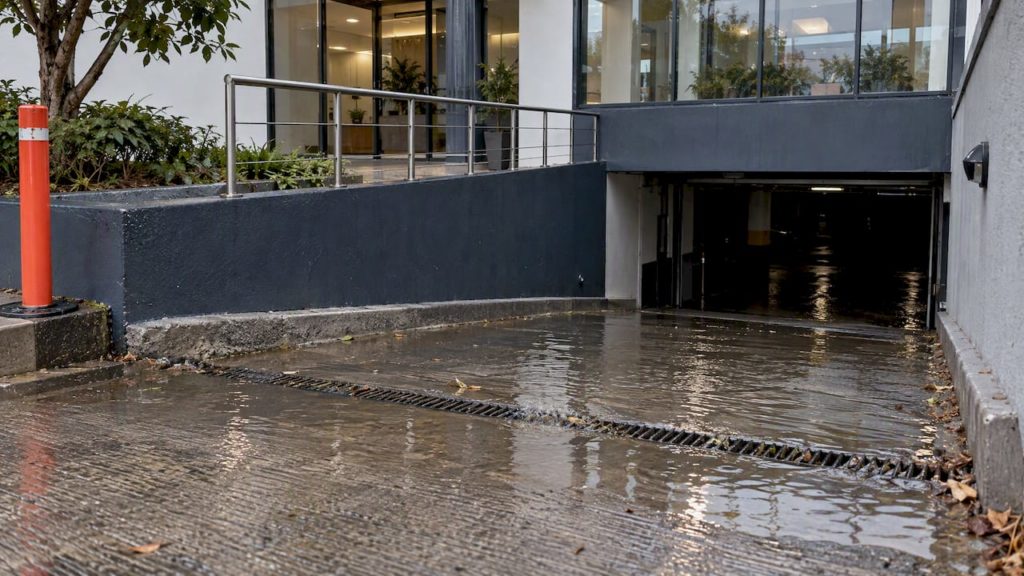
Most commercial drainage failures in Gauteng trace back to four combined causes: blocked inlets and illegal dumping, ageing municipal infrastructure with pump or power outages, design and construction faults, and extreme rainfall that overwhelms undersized systems. If you manage a commercial property, your immediate move is to inspect and clear all inlets now and call in a specialist assessment the moment you see structural cracking, repeat flooding, or any sign of ground movement nearby.
TL;DR:
- Check inlets weekly, remove sump and channel silt quarterly, arrange annual CCTV surveys, and deep clean before Gauteng’s rainy season, usually September or October.
- If drains back up during a power interruption, record the time, water level, photographs, and neighboring reports to support the response and insurance claims.
- Properties downstream of shared catchments should coordinate debris clearance with neighbors and the municipality, because upstream waste can quickly reblock cleared inlets.
- Sites with sinkhole history, unexplained settlement, or low lying locations need geotechnical or flood risk assessment; drainage upgrades alone may not address the underlying hazard.
- Clear surface debris yourself, but leave chamber entry, confined space work, and blocked main jetting to qualified contractors with proper safety equipment.
Table of Contents
- Blocked drains, debris and illegal dumping cause repeat failures
- Municipal and system-level failures beyond your boundary
- Design and construction faults that shorten system life
- A practical inspection and maintenance plan for facility managers
- Site and ground hazards: dolomite, sinkholes and low-lying sites
- Eben’s perspective: why drainage and waterproofing decisions need to happen together
- How we can help with drainage and waterproofing diagnostics
- FAQ
- Sources
- Selected authoritative reports and municipal documents to consult
Blocked drains, debris and illegal dumping cause repeat failures
Walk the perimeter of almost any commercial site in Gauteng after heavy rain and you will find the same culprits at kerb inlets and outlets: plastic sachets, food packaging, tyres and organic debris washed down from upstream catchments. These materials do not need to fully block a pipe to cause damage. A partial clog at an inlet slows flow, which lets silt settle behind it, which narrows the channel further still.

That sequence, clogging, ponding, siltation and then flow diversion, is how a minor blockage becomes an erosion problem or a flooded loading bay within a single storm season. Ekurhuleni has identified illegal dumping as the leading cause of stormwater blockages in its network, with clearance teams regularly removing tyres, animal carcasses, plastics and logs from drainage lines ahead of the rainy season.
For a facility manager, the practical implications are:
- Kerb inlets near informal settlements, taxi ranks or waste collection points need more frequent checks than those on a quiet industrial estate.
- Fencing or grating at exposed inlets reduces the volume of dumped material reaching your system.
- A single blocked inlet upstream of your property can flood your car park even if your own drainage is sound.
Municipal and system-level failures beyond your boundary
Private maintenance only goes so far when the wider network is under strain. The Gauteng dashboard published by the Department of Water and Sanitation documents high numbers of pipe leaks and limited redundancy across the province’s water infrastructure, conditions that leave pump stations and reservoirs vulnerable to outages.
Thousands of recorded leaks and strained reservoir capacity across Gauteng mean that when a pump station loses power, the knock-on effect often shows up as sewer backpressure or overflow at the property level, not just an interrupted water supply. A commercial basement or ground-floor drain that backs up during load shedding or a municipal pump failure is frequently a symptom of this wider fragility rather than a fault in the building’s own pipework.

When you suspect a municipal cause, report it with specifics: time of backup, water level reached, photographs, and whether neighbouring properties experienced the same issue. That evidence speeds up the municipality’s response and supports any insurance claim.
Design and construction faults that shorten system life
Many Gauteng commercial sites were drained to standards or budgets that have since been overtaken by denser development and heavier storms. The JRA stormwater manual sets design return periods and detailing requirements for minor and major storm systems, including correct inlet and outlet detailing and manhole benching, precisely because getting these wrong accelerates failure.
Typical faults we see on commercial properties include:
- Undersized pipes specified for an older, lower-density version of the site that now carries far more hardstanding and roof area.
- Insufficient fall or crossfall, which leaves water standing rather than draining away between storms.
- Poor inlet or outlet detailing and no allowance for overland flow when the piped system is overwhelmed.
- Substandard concrete mixes or poor jointing, visible as cracking, staining or gaps at manhole and pipe junctions.
These are not always obvious from ground level. A system can look intact for years while a slight reverse fall or an undersized pipe quietly erodes bedding material underneath, until a storm finds the weak point all at once.
A practical inspection and maintenance plan for facility managers
Reducing drainage failure risk on a commercial site mostly comes down to routine, not heroics. A sensible schedule looks like this as part of a comprehensive preventive maintenance plan:
- Carry out a weekly visual check of all inlets and gullies for debris and standing water.
- Remove silt from sumps and channels on a quarterly basis, more often where upstream dumping is a known issue.
- Commission an annual CCTV survey of underground mains to catch cracking, root ingress or joint failure before it becomes a collapse.
- Schedule a deep clean before the start of the rainy season, typically in September or October.
- Run an emergency inspection immediately after any major storm to check for new blockages or scour damage.
Clearing inlets yourself is reasonable for surface debris using a rake, gloves and a stiff brush, but anything requiring entry into a chamber, confined-space work or jetting of a blocked main should go to a qualified contractor with the right equipment and safety procedures.
Pro Tip: Coordinate clean-up with neighbouring properties and the local municipality wherever your site sits downstream of a shared catchment, since clearing your own inlets achieves little if upstream debris simply washes back in after the next storm.
Site and ground hazards: dolomite, sinkholes and low-lying sites
Some drainage failures have nothing to do with maintenance and everything to do with geology. Large parts of Gauteng sit on dolomite, where altered drainage patterns, whether from leaking pipes, changed infiltration or concentrated stormwater discharge, can enlarge underground voids and trigger sinkhole formation. This is a known regional hazard, not a routine drainage fault, and it calls for geotechnical monitoring rather than standard maintenance.
Properties sited at natural low points or close to floodplains face a related but distinct problem: even a well-designed system can be overwhelmed simply because of where the building sits. If your site has a history of sinkhole activity, unexplained ground settlement, or sits in a known low-lying area, commission a geotechnical or flood-risk study before assuming a drainage upgrade alone will solve the problem.
Eben’s perspective: why drainage and waterproofing decisions need to happen together
Treating drainage and waterproofing as separate problems is a common mistake. A damp wall or a failed membrane often has its root cause in a flow path diverted by a blocked drain, not a defect in the waterproofing itself. The sequence that works is to inspect the drainage first, correct the flow paths, and only then apply or repair waterproofing where it is genuinely needed.
— Eben
How we can help with drainage and waterproofing diagnostics
When repeat flooding, damp patches or cracking suggest drainage is driving damage to your building, a combined diagnostic saves you from fixing the symptom while the cause keeps working against you. We provide assessments related to waterproofing and drainage issues, and a thorough assessment on a commercial site typically covers:
- A visual inspection of inlets, channels and visible pipework for blockages, wear and incorrect detailing.
- CCTV survey of underground runs where a hidden defect is suspected.
- Silt and debris analysis to identify whether upstream catchments are contributing to the problem.
- Referral for a geotechnical assessment where dolomite or ground movement risk is identified.
If your property is showing signs that drainage and water ingress are connected, get in touch through our waterproofing services page to arrange an assessment and find out what the next step looks like for your building.
FAQ
How do I solve a drainage issue on a commercial property?
Start by clearing visible debris from inlets and gullies, then check whether water is backing up from the municipal system or originating on-site. Where the problem persists after basic clearance, a CCTV survey and professional assessment will identify whether the cause is a blockage, a design fault or ground-related movement.
What is the current situation with the water crisis in Gauteng?
Gauteng’s water system faces high numbers of leaks and limited redundancy, according to the DWS Gauteng dashboard, which leaves pump stations and reservoirs vulnerable during power interruptions. These wider system pressures often show up at property level as backpressure, intermittent supply or sewer overflow.
What problems were caused by open drains and poor stormwater management?
Open, poorly maintained drains collect illegally dumped debris, which Ekurhuleni has named as a leading cause of blockages, ponding and localised flooding. Left unresolved, this debris build-up diverts flow, erodes channels and damages adjacent roads and property.
How long do commercial drainage systems typically last?
Service life depends heavily on design, materials and maintenance rather than age alone, since an undersized or poorly detailed system can fail within a few years while a well-maintained one lasts for decades. Routine inspection, including annual CCTV surveys of underground mains, is the most reliable way to catch deterioration before it causes a failure.
When should I call in a specialist instead of handling drainage maintenance myself?
Surface debris at inlets is safe to clear yourself with basic tools, but recurring flooding, cracking, ground settlement or any suspected sinkhole risk needs a qualified contractor or geotechnical specialist. These signs point to causes beyond routine maintenance, including design faults or dolomite-related ground movement.
Sources
- SA SuDS guidelines (WRC)
- Gauteng dashboard (DWS)
- Stormwater infrastructure prepared for heavy rains (Ekurhuleni)
- Midvaal roads and stormwater master plan (Annexure P)
- JRA stormwater manual
Selected authoritative reports and municipal documents to consult
- Gauteng dashboard (DWS)
- Stormwater infrastructure prepared for heavy rains (Ekurhuleni)
- Midvaal roads and stormwater master plan (Annexure P)
- SA SuDS guidelines (WRC)
- JRA stormwater manual