

TL;DR:
- Choosing the correct waterproof membrane is vital for flat roof durability, with installation quality often outweighing material choice. Proper preparation, detailing, and regular maintenance prevent failures and extend the membrane’s lifespan significantly. The right selection depends on roof use, exposure, and professional installation to ensure long-term performance and protection.
Choosing the right waterproof membrane for a flat roof is one of the most consequential decisions you will make as a property owner. Unlike pitched roofs, flat and low-slope roofs cannot shed water through gravity alone, which means any weakness in the waterproofing layer gets tested every time it rains. Get the membrane selection wrong, or cut corners on installation, and you are looking at water ingress, damaged insulation, structural decay, and repair bills that dwarf the original cost of doing the job properly. This guide covers membrane types, installation principles, maintenance routines, and how to match the right product to your property.
Table of Contents
- Key takeaways
- Common types of waterproof membrane for flat roofs
- Installation principles and common pitfalls
- Maintenance, inspection, and repair
- Choosing the right membrane for your property
- My honest take on flat roof membranes
- Professional flat roof waterproofing with Prowaterproofing
- FAQ
Key takeaways
| Point | Details |
|---|---|
| Membrane type matters, installation matters more | Even the best membrane will fail without correct seam welding, flashing, and substrate preparation. |
| EPDM offers exceptional longevity | With proper maintenance, EPDM membranes can last between 20 and 50 years, making them a cost-effective long-term choice. |
| Drainage design is non-negotiable | Persistent ponding water damages membranes, voids warranties, and causes hidden structural harm over time. |
| Inspect regularly at the critical points | Seams, flashings, and penetrations are where failures originate. Catching problems early prevents costly repairs. |
| Match the membrane to your roof’s use | Foot traffic, climate exposure, and energy efficiency goals all influence which flat roof waterproofing solution is right for you. |
Common types of waterproof membrane for flat roofs
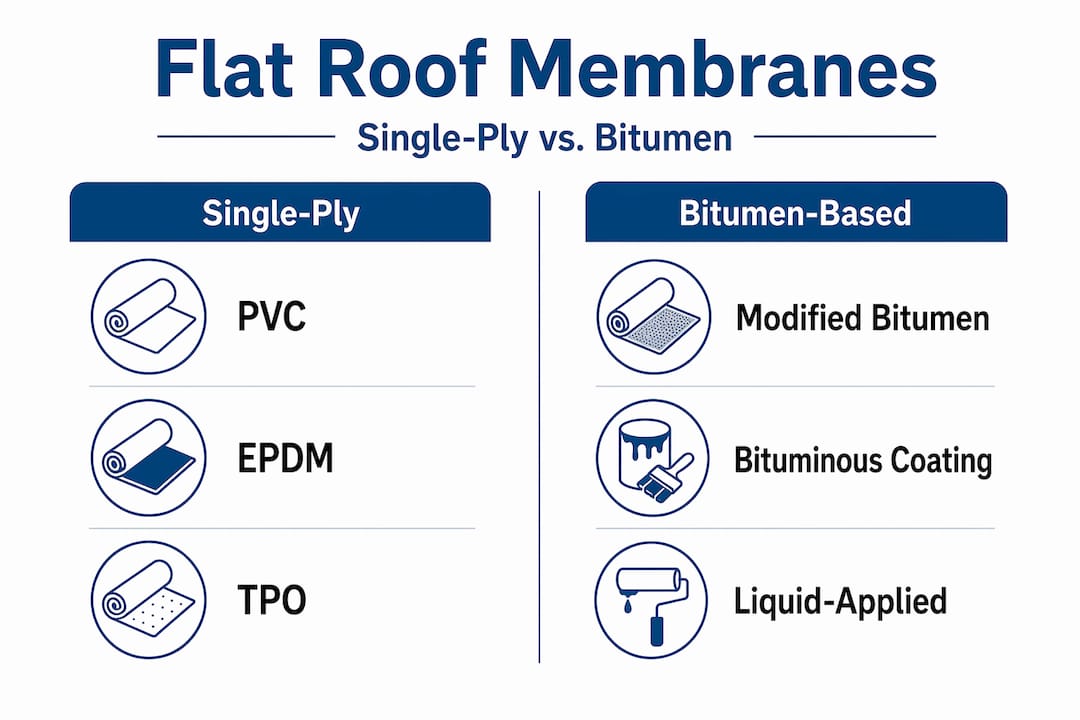
Not all membranes are created equal, and understanding the differences will save you from an expensive mismatch. The three dominant categories for flat roof waterproofing materials are single-ply membranes, modified bitumen systems, and liquid-applied membranes. Each has distinct strengths depending on the application.
Single-ply membranes: PVC, EPDM, and TPO
Single-ply membranes are factory-manufactured sheets rolled out and fixed to the roof deck, either mechanically, with adhesive, or ballasted. PVC (polyvinyl chloride) membranes are popular for commercial roofs because they weld thermoplastically, creating seams that are as strong as the membrane itself. They resist chemicals, fire, and root penetration, which makes them a strong choice for rooftop gardens or kitchens with grease-laden air vents.
EPDM (ethylene propylene diene monomer) is the workhorse of the single-ply world. EPDM membranes last between 20 and 50 years with periodic inspections, a lifespan that few competing materials can match at a comparable price. Self-adhesive reinforced EPDM variants take the process further by eliminating hot works entirely, remaining fully elastic down to minus 40°C, and offering excellent UV and ozone resistance. That makes them particularly practical for properties where open-flame equipment is a safety concern.
TPO (thermoplastic polyolefin) sits between PVC and EPDM in terms of cost and performance. It reflects solar heat effectively, which benefits buildings in warm climates where cooling costs are a concern. TPO is heat-welded like PVC, but its formulations vary more between manufacturers, so verifying product quality and installer experience is worth the effort.
Modified bitumen and bituminous coatings
Modified bitumen membranes are essentially an evolution of traditional felt-based roofing. APP (atactic polypropylene) and SBS (styrene butadiene styrene) modifiers are blended into bitumen to improve flexibility and UV resistance. These systems are applied by torch, cold adhesive, or self-adhesion, making them familiar to many South African contractors. They perform well on roofs with complex detailing and are straightforward to repair.
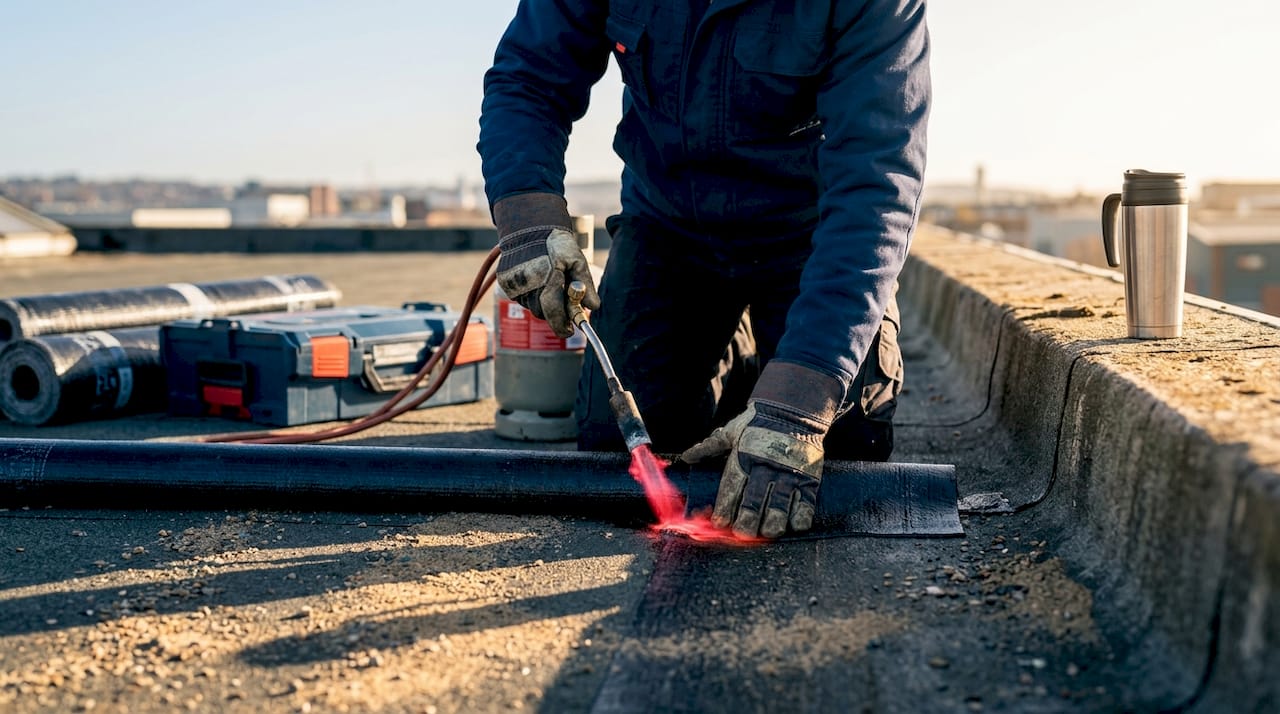
Bituminous coatings, sometimes referred to loosely as the best waterproof paint for flat roofs, are liquid-applied versions that brush or roll on. They are more suited to maintenance overcoating or smaller areas than to primary waterproofing on large exposed roofs.
Liquid-applied membranes
Liquid-applied systems cure in place to form a seamless, monolithic waterproofing layer. That seamless quality is their biggest advantage because failures often originate at seams, laps, and penetrations. With no seams to weld, those failure points are dramatically reduced. They are excellent around complex detailing such as pipes, drains, and upstands. The trade-off is that they require precise mixing ratios and multiple coats to reach the specified thickness, and thickness inconsistencies can compromise the whole coating.
| Membrane type | Typical lifespan | Best suited for | Key limitation |
|---|---|---|---|
| EPDM | 20 to 50 years | Residential and commercial, low traffic | Dark colour absorbs heat |
| PVC | 20 to 30 years | Commercial, chemical exposure, green roofs | Plasticiser migration over time |
| TPO | 15 to 25 years | Warm climates, energy-conscious builds | Quality varies by manufacturer |
| Modified bitumen | 15 to 25 years | Complex details, retrofit work | Torch application fire risk |
| Liquid-applied | 10 to 20 years | Intricate detailing, overcoating | Application-sensitive, multi-coat required |
Installation principles and common pitfalls
Selecting the best membrane for flat roofs only gets you halfway there. How it goes down determines whether it actually works. This is the area where most flat roof failures begin, and where most property owners are least informed.
Substrate preparation and detailing
Before any membrane touches the roof, the deck must be clean, dry, sound, and free of sharp protrusions. Any moisture trapped under a fully adhered membrane will cause blistering. Any contamination will prevent adhesive bonding. Rushing substrate preparation is the single most common cause of early membrane failure.
Penetrations, upstands, and roof-to-wall junctions need to be detailed correctly. Detailed waterproofing at transitions, including gutters, outlets, parapets, and anti-slip walkways, is where long-term success is won or lost. A membrane sheet that is perfectly installed across the flat field area will still leak if the upstands are incorrectly terminated.
Overlaps, welding, and upturns
PVC membranes require welded overlaps of at least 5 cm, using hot-air welding or chemical agents, and vertical upturns of at least 20 cm above the finished roof level. Those numbers are not conservative estimates. They are the minimum requirements to keep water from tracking behind the membrane during heavy rainfall.
Joint quality must be verified, not assumed. Correct welding methods per the manufacturer’s specification are what deliver homogeneous joints that last. Physical joint testing, including a probe check along the weld line, should be standard practice on every installation.
- Clear the roof deck of all debris, old coating remnants, and standing water before laying any primer or membrane.
- Prime the substrate according to the membrane manufacturer’s specification, paying particular attention to porous surfaces.
- Detail all upstands, penetrations, and drainage outlets before rolling out the main membrane field.
- Weld or bond overlaps to the minimum specified width and check every seam immediately after completion.
- Install edge trims and termination bars to secure and protect all membrane edges against wind uplift and water ingress.
- Test drainage under controlled conditions before handing the roof back to the property owner.
Pro Tip: Ask your contractor to show you a physical probe-test result on every seam before you sign off on the installation. A seam that looks welded can still delaminate if the temperature, speed, or overlap width was outside specification.
Drainage design ties everything together. Persistent ponding water voids warranties and causes hidden structural damage over time. A membrane may tolerate temporary standing water, but that tolerance is not a substitute for a properly sloped roof deck and correctly positioned outlets.
Maintenance, inspection, and repair
A well-installed membrane will not look after itself indefinitely. Regular inspections are what turn a 20-year-rated product into a roof that actually reaches 20 years.
The inspection routine does not need to be complicated. Twice a year, ideally in autumn before the rainy season and in spring after it, carry out a visual check focusing on:
- Seams and laps for any lifting, splitting, or visible gaps
- Flashings at walls, parapets, and upstands for separation or cracking
- Drainage outlets and gutters for blockages and debris accumulation
- The membrane surface for blistering, punctures, or unusual discolouration
- Any areas where foot traffic has worn through a protective coating
Blocked outlets and gutters are more than a maintenance nuisance. Waterproofing performance depends on the entire roofing assembly, and a blocked drain that creates a pond over a vulnerable seam will find a weakness long before the membrane reaches its rated lifespan.
When you spot a problem, act quickly. A small blister or lifted lap edge is a straightforward repair. Left for a season, it becomes a leak. Left for several seasons, it becomes a rotten deck or damaged insulation. The cost of ignoring roof damage compounds faster than most property owners realise.
Pro Tip: After any significant storm, carry out a rapid visual inspection of flashings and outlets before the next rainfall. Storms dislodge debris and create blockages that turn a one-hour downpour into a week-long water ingress problem.
Minor repairs to single-ply membranes can often be carried out with compatible patch material and adhesive. Modified bitumen systems can be spot-torched where small areas have lifted. Liquid-applied coatings can be overcoated once the substrate is dry and clean. For anything involving failed seams, widespread delamination, or structural deck damage, professional assessment is not optional.
Choosing the right membrane for your property
The best flat roof waterproofing solution for your building depends on factors that go beyond the product datasheet. Before committing to a system, work through these practical considerations:
- Roof use: A rooftop terrace with regular foot traffic needs a membrane with a protective wear layer or dedicated paving system on top. An inaccessible plant room roof has entirely different requirements.
- Exposure conditions: South African properties face intense UV radiation and significant thermal cycling. EPDM and quality TPO both handle UV well. Membrane options suited to South African climates deserve specific attention when selecting materials.
- Energy efficiency: TPO and white-coated membranes reflect solar radiation, reducing cooling loads in warm climates. Dark EPDM absorbs heat, which can be a disadvantage in summer-dominant climates unless the building benefits from passive heat gain.
- Compatibility with existing materials: Retrofitting over an existing roof requires checking whether the new membrane’s adhesives or primers are compatible with the existing substrate. Some solvents in liquid-applied systems attack polystyrene insulation.
- Contractor verification: Ask for evidence that the installer is trained and approved by the membrane manufacturer. Many product warranties require certified installation. An uncertified contractor installs a membrane at your risk, not theirs.
Longevity versus upfront cost is a genuine trade-off. EPDM costs more per square metre than modified bitumen, but over a 25-year period, the lower maintenance frequency and longer replacement cycle often make it the more economical choice. For a complete overview of flat roof waterproofing options and ponding considerations, the underlying article at Prowaterproofing is worth reading alongside this guide.
My honest take on flat roof membranes
I have seen too many property owners spend weeks comparing membrane brands and datasheets, then hand the job to the cheapest contractor available. That is the wrong priority order. In my experience, installation quality dominates waterproofing success far more than membrane type.
A mid-range EPDM membrane installed by a skilled, experienced contractor will outlast a premium PVC system put down by someone who rushes the seam preparation. I have walked roofs where the membrane itself was in excellent condition but every single leak originated at a flashing that was terminated 10 cm too low, or a drain outlet that was never properly collared. The membrane got the blame. The installation was the problem.
What I find people underestimate most is the maintenance side. The property owners who get 30 years from a 20-year-rated membrane are not lucky. They are the ones who clean their gutters in April and October, who get someone up on the roof after a major storm, and who fix a lifted lap edge before it becomes a saturated deck board. That level of attention costs very little and protects a significant asset.
My advice: spend your research time on the contractor’s credentials and installation process, not just the membrane specification. Ask what detailing method they use at upstands, how they verify seam quality, and what their drainage assessment process looks like before installation begins. Those questions will tell you more about the outcome than any product comparison.
— Eben
Professional flat roof waterproofing with Prowaterproofing
If you are at the point of planning a flat roof membrane installation or assessing an existing roof that has started showing signs of failure, professional input at the right stage saves significant money.
Prowaterproofing works with residential, commercial, and industrial property owners across South Africa, offering expert assessment, membrane selection guidance, and certified installation for all major flat roof waterproofing solutions. The team at Prowaterproofing understands how South African climate conditions affect membrane performance and can recommend the most durable, cost-appropriate system for your specific roof. Whether you need a full membrane replacement, a targeted repair, or an independent inspection before buying or leasing a property, the process starts with a no-obligation consultation. Do not wait for a visible leak to act. By the time water appears on a ceiling, the damage to insulation and deck structure is typically already significant.
FAQ
What is the best waterproof membrane for a flat roof?
EPDM is widely regarded as the best all-round membrane for flat roofs due to its lifespan of 20 to 50 years, UV resistance, and flexibility in cold temperatures. PVC is the preferred choice where chemical resistance or welded seam strength is the priority.
How long does a flat roof waterproofing membrane last?
Lifespan varies by material. EPDM typically lasts 20 to 50 years, PVC and TPO between 15 and 30 years, and modified bitumen systems between 15 and 25 years, all subject to correct installation and regular maintenance.
What causes most flat roof membrane leaks?
Most leaks originate at seams, flashings, and penetrations rather than in the flat membrane field. Poor seam welding, inadequate upturn heights, and blocked drainage are the leading causes of failure.
Can I install a waterproof membrane myself?
Liquid-applied coatings are manageable for small areas as a maintenance overcoat, but full membrane systems require professional installation to meet manufacturer warranty conditions and to achieve correct seam quality and detailing at penetrations.
How often should a flat roof membrane be inspected?
Twice a year is the recommended minimum, with additional checks after significant storms. Focus inspections on seams, flashings, drainage outlets, and any areas subject to foot traffic or mechanical equipment.