
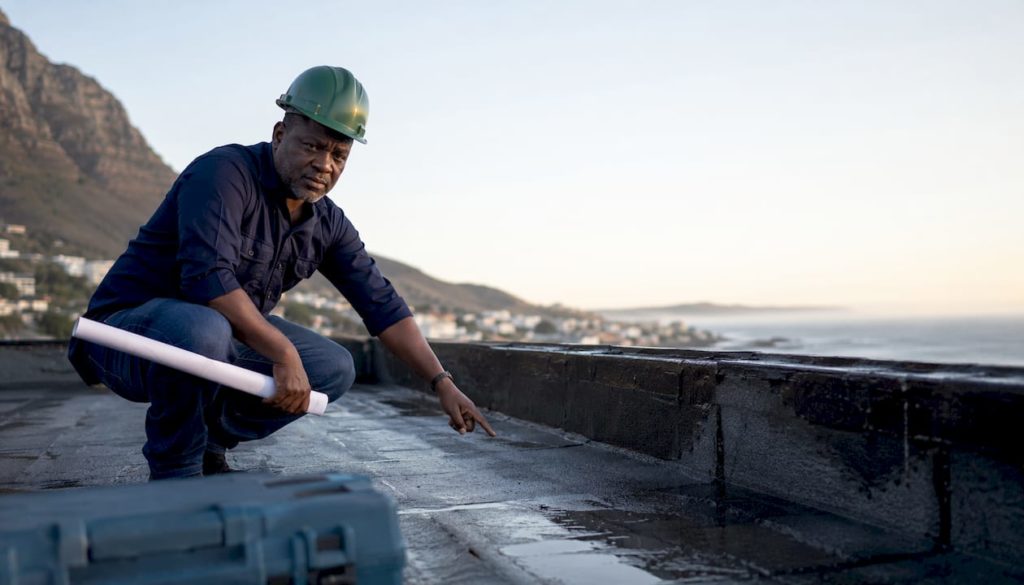
For Cape Peninsula properties, the most reliable waterproofing material families are liquid polyurethane (liquid-applied PU), EPDM rubber membranes, PVC/TPO sheet membranes, torch-on bitumen, fibreglass/GRP systems, cementitious tanking, and bentonite clay. Acrylic coatings work on sloped, well-draining surfaces only. The coastal combination of salt spray, intense UV, wind-driven rain, and ponding water rules out several cheaper options that perform adequately inland. Before specifying any system, get an on-site inspection to confirm substrate condition and falls — municipal compliance under SANS 10400-L depends on it.
Quick use-case match:
- Flat roofs (commercial or residential): liquid PU, EPDM, or torch-on bitumen with correct falls
- Complex details and penetrations: liquid-applied PU (seamless, no joints to fail)
- Balconies and terraces: fibreglass/GRP or liquid PU with positive drainage falls
- Bathrooms and wet rooms: cementitious tanking or liquid PU
- Basements and retaining walls: cementitious tanking or bentonite/swellable clay systems
Table of Contents
- Why Cape Peninsula conditions change everything about material selection
- How does each waterproofing material perform in the Cape Peninsula?
- Which material suits your specific building element?
- Installation details and maintenance: what coastal properties demand
- What do waterproofing systems cost in South Africa?
- How do you choose a reliable waterproofing contractor in the Cape Peninsula?
- What the research says about liquid-applied systems and municipal compliance
- Key takeaways
- The mistake most Cape Peninsula property owners make
- Prowaterproofing: on-site inspections and written warranties for Cape Peninsula properties
- Useful sources and standards for further reading
Why Cape Peninsula conditions change everything about material selection
Coastal conditions in the Cape Peninsula impose stresses that simply do not apply to Johannesburg or Pretoria. UV radiation here is intense year-round, salt-laden air accelerates corrosion of metal flashings and degrades certain polymer membranes faster than manufacturers’ inland test data suggests, and the region’s notorious south-easter drives rain horizontally into joints, laps, and turn-ups that would never see water on a sheltered inland site.
Ponding is the other major factor. Flat roofs that drain slowly trap water for hours or days after a winter storm, and standing water breaks down bitumen-based systems and acrylics far more quickly than intermittent wetting. Wind-driven rain also forces water behind poorly detailed flashings at parapet walls and around penetrations, which is where most Cape Peninsula failures actually originate.
Salt spray affects more than flashings; for local supplier options and technical product details, consult the Sealtek Cape sitemap. Within roughly 1 km of the coastline, SANS 10400-K requires stainless steel or heavily galvanised wall ties and reinforcement. The same corrosive environment attacks the metal components of waterproofing systems: lead flashings, aluminium termination bars, and steel roof decks all need additional protection or material substitution in coastal zones.
Pro Tip: Prioritise systems with documented salt-air resilience and specify correct drainage falls from the outset. SANS 10400-L requires a minimum fall of 1:80 toward outlets on flat roofs, but 1:50 is the practical site standard — construction tolerances mean 1:80 on paper often becomes near-flat in practice.
How does each waterproofing material perform in the Cape Peninsula?
Understanding the waterproofing materials available for South African construction is the starting point. Here is how each family performs under coastal conditions.
Torch-on bitumen membranes
Torch-on is the most widely used system on South African flat roofs and is well understood by local contractors. A properly installed two-layer torch-on system with a UV-stable mineral cap sheet performs adequately in the Cape Peninsula, but it has real weaknesses here. The flame application process is restricted or prohibited on certain substrates and in fire-risk zones, and the material becomes brittle over time under intense UV if the cap sheet is not UV-stabilised. Delamination from dense concrete substrates is a known risk unless a sand-cement screed is laid first to allow moisture dissipation. Typical lifespan: adequate duration with maintenance.
Liquid polyurethane (liquid-applied PU)
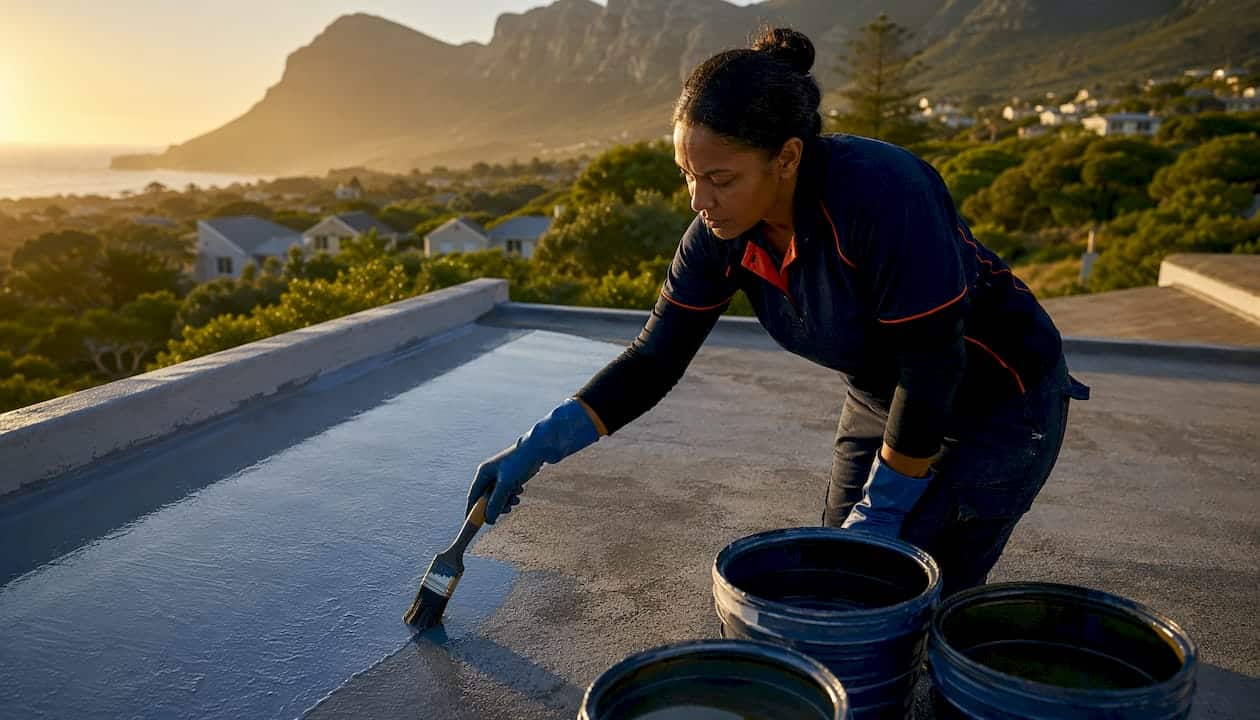
Liquid PU is arguably the best all-round choice for the Cape Peninsula. Applied as a cold-liquid reinforced system (primer, base coat, reinforcement fleece, top coat), it forms a seamless membrane with no laps or joints for wind-driven rain to exploit. Products such as Sikalastic-625 are formulated for complex shapes, penetrations, and coastal climates when applied per the manufacturer’s data sheet. Liquid-applied systems also show fewer defects on municipal compliance inspections in complex residential work than sheet membranes. The trade-off is cost: liquid PU sits at the higher end of the price range, and application requires a trained installer who follows the correct dry-film thickness and cure-time protocols. Typical lifespan: 20 years when correctly installed and maintained.
EPDM rubber membranes
EPDM is exceptionally flexible and UV-resistant, with product literature and local guides indicating a long potential lifespan when correctly detailed. It handles the Cape Peninsula’s temperature swings and UV load better than most alternatives and is a strong choice for flat roofs, green roofs, and water features. The main limitation is that EPDM requires specialist installation for laps and penetrations — a poorly bonded lap seam in a wind-exposed location is a common failure point. It is also less forgiving of substrate irregularities than liquid-applied systems.
PVC and TPO synthetic membranes
PVC and TPO membranes are heat-welded sheet systems that produce strong, consistent seams when installed correctly. They are popular for western cape commercial waterproofing applications on large flat roofs because installation is fast and quality control on seams is straightforward. PVC is more flexible at low temperatures; TPO offers better UV resistance and is increasingly preferred for coastal industrial roofs. Both systems require specialist welding equipment and trained operators. Typical lifespan: a suitable range for the intended use.
Acrylic roof coatings
Acrylics are widely sold in South Africa and are genuinely useful on sloped, well-draining surfaces — pitched roofs, IBR sheeting, and tiled roofs with minor porosity issues. The problem is that acrylic coatings on flat roofs with ponding water fail faster than almost any other system. The initial saving over liquid PU or EPDM is typically outweighed by higher maintenance frequency and earlier replacement in the Cape Peninsula’s wet winters. Use acrylics only where water drains away within minutes of rain stopping.
Fibreglass/GRP systems
Fibreglass (glass-reinforced polyester, GRP) produces a rigid, seamless shell that is excellent for balconies, walkways, and small flat roofs with complex upstands. It bonds well to timber and concrete substrates, tolerates foot traffic, and is straightforward to repair with patch kits. The rigidity that makes GRP durable on stable substrates is also its weakness: it can crack on substrates that move or flex, so it is less suitable for large roof areas over lightweight structures. Typical lifespan: 20 years when applied to stable substrates.
Cementitious waterproofing (tanking)
Cement-based tanking systems are the standard choice for internal wet areas, bathrooms, shower trays, and below-ground applications. They bond directly to masonry and concrete, tolerate hydrostatic pressure from the wet side, and are compatible with tile adhesives. They are not flexible enough for exposed roofs or surfaces subject to thermal movement, and they require a clean, sound substrate. Typical lifespan: varies based on product and application technique.
Bentonite (swellable clay systems)
Bentonite panels or granular systems are mainly used for below-ground waterproofing such as basements and retaining walls. The clay swells on contact with water to form a self-sealing barrier. Bentonite is unsuitable for exposed or above-ground applications and requires soil confinement to function. It is commonly used for basement construction in areas with groundwater pressure concerns.
Which material suits your specific building element?
Matching the right system to the right part of the building prevents most failures. Comparing waterproofing methods for South African properties shows that substrate type, drainage, and access for future maintenance are the three variables that matter most.
Flat roofs are the highest-risk element in the Cape Peninsula. EPDM, liquid PU, or a quality two-layer torch-on system with a UV-stable cap sheet are all appropriate, but only if falls are correct and outlets are unobstructed. On commercial flat roofs with large areas and multiple penetrations, liquid PU or PVC/TPO welded membranes are preferable because they eliminate the laps and joints that wind-driven rain exploits.
Pitched roofs with IBR sheeting or tiles generally need coating rather than membrane systems. Acrylics are acceptable here provided the pitch is sufficient for rapid drainage. Where sheeting has corroded or joints have opened, a reinforced liquid PU or torch-on strip repair is more durable than a brush-applied coating.
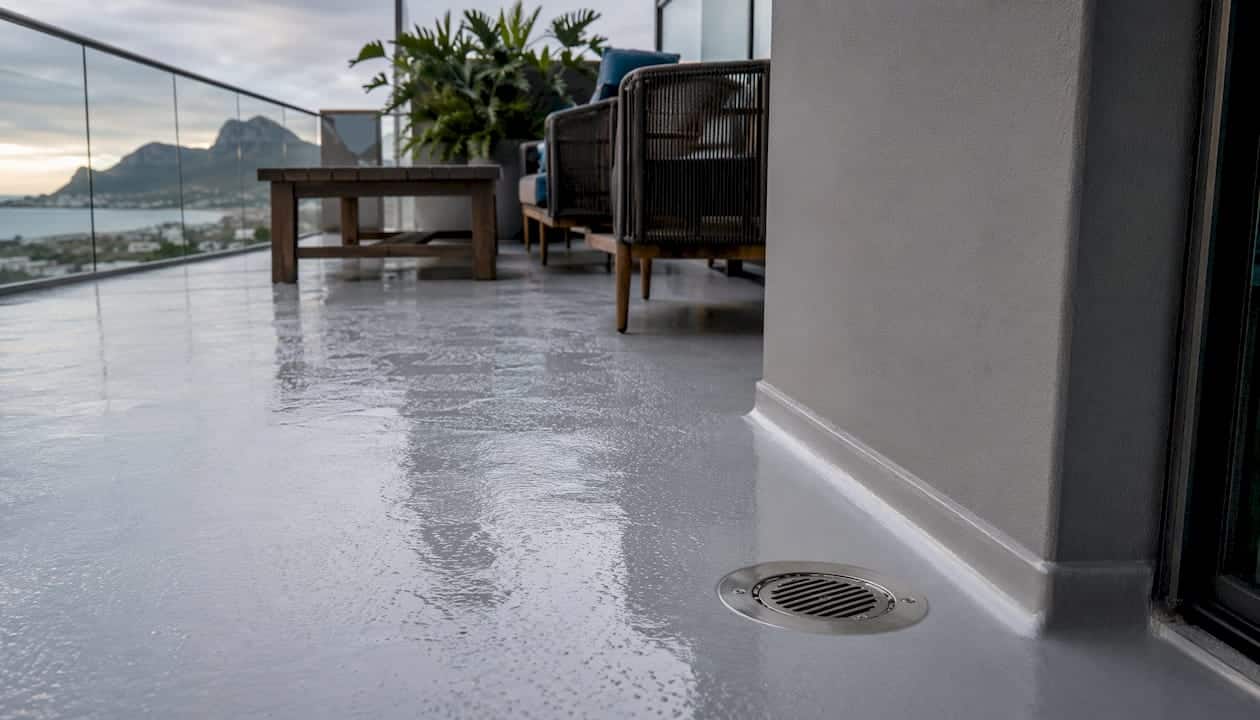
Balconies and terraces combine foot traffic, ponding risk, and exposure to the full coastal environment. GRP is the first choice for small balconies with timber or concrete substrates. Liquid PU with a UV-stable top coat and anti-slip aggregate is the alternative for larger or more complex areas. Positive falls of at least 1:50 are non-negotiable — a balcony that ponds will fail regardless of the membrane specified.
Bathrooms and wet rooms need a system that tolerates permanent moisture and is compatible with tile adhesive. Cementitious tanking applied to walls and floor before tiling is the standard approach. Liquid PU is an alternative where substrate movement is a concern, but it must be confirmed as compatible with the tile adhesive being used.
Basements and retaining walls require systems that resist hydrostatic pressure. Cementitious tanking applied from the wet side (negative-side waterproofing) works for existing structures. For new construction, bentonite panels applied to the external face before backfilling provide the most reliable long-term barrier and are self-healing if minor damage occurs during construction.
Installation details and maintenance: what coastal properties demand
Getting the material right is half the job. Poor installation accounts for the majority of waterproofing failures in the Cape Peninsula, and most defects are traceable to a handful of skipped steps.
Installation checklist for Cape Peninsula properties:
- Surface preparation: remove all loose material, laitance, and contamination. Concrete must be sound and clean.
- Substrate moisture: confirm moisture content is within the manufacturer’s limit before application. SANS 10400-L specifies drying limits; dense concrete may require a 20 mm sand-cement screed to allow moisture dissipation and prevent delamination.
- Falls and drainage: verify falls meet the 1:80 minimum (1:50 recommended) toward outlets. Correct any low spots with screed before applying the membrane.
- Coves and fillets: form 45-degree fillets at all wall-to-floor junctions to prevent stress concentration and bridging failure.
- Flashings and turn-ups: membranes must turn up a minimum of 150 mm onto vertical faces at parapets and walls. In wind-exposed Cape Peninsula locations, 200 mm is better practice.
- Pipe and penetration details: all pipes, drains, and service penetrations must be individually dressed with reinforcement and sealant before the main membrane is applied.
- Primer application: apply the correct primer for the substrate and allow it to cure fully before the membrane coat.
- Reinforcement layers: for liquid-applied systems, embed reinforcement fleece in the base coat at all junctions, laps, and penetrations.
Common failure modes in the Cape Peninsula:
- Ponding-related breakdown on flat roofs where falls were not corrected before membrane application
- Delamination from dense concrete where no screed was used and moisture was trapped
- Flashing failure at wind-exposed parapet edges where turn-ups were too short or not mechanically fixed
- Salt-driven corrosion of aluminium termination bars and lead flashings within 1 km of the coast
- Cracking at pipe penetrations where no reinforcement was applied
Routine maintenance tasks:
- Clear gutters and outlets before and after winter (May and September at minimum)
- Inspect for blisters, cracks, and open laps after major storms
- Reseal pipe penetrations and expansion joints every 3–5 years
- Check flashing fixings and sealant at parapet edges annually
Pro Tip: When requesting quotes, ask contractors to provide before-and-after detail photos of turn-ups, pipe flashings, and outlet dressings from previous jobs. Contractors who document substrate moisture readings and photograph critical details substantially reduce the chance of municipal inspection failures.
What do waterproofing systems cost in South Africa?
Upfront cost is rarely the right metric. A system that costs R80/m² and lasts eight years in coastal conditions is more expensive over 20 years than one that costs R180/m² and lasts 20 years. SANS 10400-L sets minimum durability periods of 10 years for readily repairable systems and 20 years for systems that are difficult to replace — a useful benchmark when evaluating quotes.
| System | Typical lifespan | Indicative cost (ZAR/m²) | UV/salt resistance | Ponding tolerance | Specialist installer needed |
|---|---|---|---|---|---|
| Torch-on bitumen (2-layer) | 10 years | R80–R150 | Moderate (UV cap sheet needed) | Moderate | Yes |
| Liquid polyurethane (reinforced) | 20 years | R150 | High | High | Yes |
| EPDM rubber | 30–50 years | R180 | Very high | High | Yes |
| PVC/TPO membrane | 15 years | R160 | High (TPO superior) | High | Yes |
| Acrylic coating | 5–10 years | R80 | Moderate | Low (sloped only) | No |
| Fibreglass/GRP | 20 years | R200 | High | Moderate | Yes |
| Cementitious tanking | 10–20 years | R60 | N/A (internal use) | High (negative side) | No |
| Bentonite clay | 20–30 years | R120 | N/A (below ground) | High (below ground) | Yes |
Cost bands are indicative for the South African market and vary with substrate condition, access, and project size. Substrate repair, fall correction with screed, and priming can add R30–R80/m² to any system. Always confirm what a quote includes: surface preparation, primers, reinforcement, detail work at penetrations, and VAT. A quote that omits substrate repair is not a like-for-like comparison with one that includes it.
Budget for at least one intermediate maintenance application at the halfway point of the system’s design life for acrylics and torch-on systems. Liquid PU and EPDM systems generally need only inspection and minor resealing at penetrations.
How do you choose a reliable waterproofing contractor in the Cape Peninsula?
The material is only as good as the installer. Western cape waterproofing contractor selection criteria matter more than most property owners realise, because a poorly installed premium system will fail faster than a correctly installed mid-range one.
Questions to ask before appointing a contractor:
- Can you provide evidence of manufacturer accreditation or SABS-aligned product approvals for the system you are specifying?
- Do you have local references and before/after detail photos from similar Cape Peninsula projects?
- What does your workmanship warranty cover, for how long, and what conditions would void it?
- Who supplies the materials — you or the client — and can you provide the manufacturer’s technical data sheet for the specified product?
- Do you carry public liability insurance, and can you provide a written method statement before work starts?
- Will you provide a written watertightness guarantee on completion?
Red flags to watch for:
- A price significantly below other quotes with no explanation and no substrate inspection
- Refusal to provide a written method statement or method of application
- No local references or photos of completed detail work (turn-ups, pipe flashings, outlet dressings)
- Verbal-only warranties or guarantees that do not specify scope, period, or conditions
- Contractors who propose applying a new coating directly over an existing failed membrane without investigation
Warranty checklist — confirm in writing:
- Material warranty (from the manufacturer) versus workmanship warranty (from the contractor): both should be present
- Period: a minimum of five years for workmanship on a new installation is a reasonable expectation; some liquid PU systems carry 10-year manufacturer warranties
- Scope: what defects are covered and what is excluded (e.g. damage from subsequent trades, blocked outlets)
- Conditions for voiding: confirm that routine maintenance obligations are clearly stated
What the research says about liquid-applied systems and municipal compliance
Liquid-applied waterproofing systems consistently show fewer defects during municipal compliance inspections than sheet membranes on complex residential applications in South Africa. The practical implication is straightforward: fewer defects mean faster approvals, fewer reworks, and lower total project cost for homeowners and property managers navigating Cape Town’s building control process.
The reason is geometry. Sheet membranes must be lapped, folded, and heat-welded or torch-fused at every junction, penetration, and change of direction. Each of those joints is a potential defect. A liquid-applied system flows into corners, around pipes, and across irregular substrates without joints, which is why it performs better on inspections in complex residential work.
For municipal compliance in Cape Town, this matters practically. The City of Cape Town’s building inspectors check waterproofing details as part of occupation certificate sign-off, and rework is expensive and time-consuming.
Documentation to request from your contractor before work starts:
- Written method statement specifying surface preparation, primer, membrane system, and detail treatment
- Manufacturer technical data sheet for the specified product (check adhesion values, UV resistance rating, recommended substrate moisture limits, and warranty terms)
- Relevant Agrément South Africa certificate or SABS product approval where available
- Proof of manufacturer accreditation for the installer
Key takeaways
For Cape Peninsula properties, liquid polyurethane, EPDM, and PVC/TPO systems offer the best combination of UV resistance, salt tolerance, and ponding performance — and correct falls and substrate preparation matter as much as the material itself.
| Point | Details |
|---|---|
| Match material to use-case | Liquid PU or EPDM for flat roofs; GRP or liquid PU for balconies; cementitious tanking for bathrooms and basements. |
| Falls are non-negotiable | SANS 10400-L requires a minimum 1:80 fall; use 1:50 in practice to account for construction tolerances. |
| Avoid acrylics where water ponds | Acrylic coatings are only suitable for sloped, well-draining surfaces; ponding accelerates failure significantly. |
| Demand written warranties | Insist on both a manufacturer material warranty and a contractor workmanship warranty before work starts. |
| Prowaterproofing for Cape Peninsula projects | Prowaterproofing provides on-site inspections, method statements, and written warranties for residential and commercial properties across the Cape Peninsula. |
The mistake most Cape Peninsula property owners make
The most common error is specifying a material based on price per square metre without accounting for the substrate condition, the drainage geometry, or the coastal environment. A R60/m² acrylic coating applied over a flat roof with no falls and a damp concrete substrate will fail within two winters. The repair cost, including substrate remediation and a proper membrane system, will be three to four times what a correct installation would have cost at the outset.
What separates contractors who get it right from those who do not is almost always the substrate inspection. The ones who measure moisture content, check falls with a level, and photograph every penetration before they quote are the ones whose work lasts. The ones who arrive with a brush and a tin and leave the same day are the ones whose clients call back two years later with a leak.
There is also a tendency to underestimate the wind. The Cape Peninsula’s south-easter is not just a nuisance — it is a structural force on waterproofing details. Turn-ups that are 100 mm high and held with a bead of silicone will lift. Flashings that are not mechanically fixed will peel. The detailing requirements for semi-detached Cape homes and commercial buildings here are genuinely more demanding than for sheltered inland properties, and the specification needs to reflect that.
Prowaterproofing: on-site inspections and written warranties for Cape Peninsula properties
Property owners who have read this far know what a proper waterproofing installation looks like. The gap between knowing and finding a contractor who actually delivers it is where most projects go wrong.
Prowaterproofing covers residential, commercial, and industrial properties across the Cape Peninsula, offering basement waterproofing, roof waterproofing, damp wall treatment, roof repair, and damp proofing. Every project starts with an on-site inspection that includes substrate moisture checks, fall assessment, and a written method statement before any work is priced. Warranties are provided in writing, covering both materials and workmanship, with scope and conditions stated clearly.
To request an inspection or get a quote, visit Prowaterproofing and use the contact form. Bring your building plans if available, and note any areas where you have already seen damp, blistering, or staining — that information helps the inspector prioritise the assessment.
Useful sources and standards for further reading
| Resource | What it covers | Why it is useful |
|---|---|---|
| SANS 10400-L: Roofs | Minimum falls, substrate moisture limits, durability periods (10 and 20 years) | Primary regulatory reference for all flat roof waterproofing in South Africa |
| SANS 10400-K: Walls | Coastal zone requirements for wall ties, reinforcement, and damp-proofing | Check for coastal zone metal specifications within 1 km of the coast |
| Sikalastic-625 product data sheet | Reinforced liquid PU membrane: adhesion, UV resistance, substrate moisture limits, warranty | Use to verify contractor specification and confirm correct application thickness |
| ServiceLink SA: roof waterproofing guide | Regional cost bands, lifespan ranges, and suitability notes for Cape Town | Practical cost benchmarking and regional suitability reference |
| TSSupplies: best waterproofing for SA roofs | Acrylic vs polyurethane comparison, ponding suitability, industrial flat roof guidance | Useful for comparing acrylic and PU systems on sloped vs flat surfaces |
| SANS10400.co.za: waterproofing roofs | Delamination risks on dense substrates, screed requirements, drying limits | Practical guidance on substrate preparation and common installation defects |
| Prowaterproofing: waterproofing regulations SA | Regulatory background and municipal inspection requirements | Owner-facing guide to satisfying Cape Town building control |