

Chemical exposure degrades waterproofing membranes by attacking polymer chains and adhesive interfaces, producing softening, embrittlement, re-emulsification or outright dissolution that opens pathways for water ingress. The damage is not always dramatic at first. You might notice a soft spot underfoot on a plaza deck, a faint petrochemical odour near a drainage sump, or an oily sheen on standing water. Those are the early signals. Left unchecked, the membrane loses tensile strength and bond, and the leak follows.
The practical outcomes to watch for immediately:
- Soft or spongy areas where the membrane has swollen or dissolved
- Discolouration, staining or an oil-slick film on ponded water
- Blistering or delamination at laps and terminations
- A solvent or chemical odour emanating from the membrane surface
- Visible cracking or surface embrittlement in areas away from UV exposure
Three factors control how fast damage progresses: the chemical class (solvent, acid, alkali, oxidiser), the concentration, and the duration of contact. Temperature amplifies all three. A brief splash of dilute acid on a torch-applied SBS sheet may leave no lasting mark; continuous immersion of the same membrane in concentrated sulphuric acid will destroy it.
Pro Tip: If you suspect chemical attack on site, collect a sample of the standing water or liquid in a clean, sealed container and contact the membrane manufacturer immediately. Request the product’s chemical-resistance chart and a written compatibility statement for the specific chemical identified. That single step can save weeks of guesswork.
Table of Contents
- Why chemical exposure damages waterproofing membranes: the mechanisms
- Which chemical classes put your membrane at risk?
- How different membrane types respond to chemical exposure
- How to detect chemical damage in the field
- How to specify and design against chemical damage
- What to do when chemical damage is already present
- South African standards and what to verify before you specify
- Key takeaways
- The part most specifications get wrong
- Useful sources for specification and testing
Why chemical exposure damages waterproofing membranes: the mechanisms
Chemicals reach a membrane and then do one of several things, depending on their chemistry. Understanding which mechanism is at work tells you what you will see on site and what the repair options are.
Solvent dissolution and swelling. Aromatic solvents such as toluene and xylene, ketones such as acetone, and chlorinated solvents such as methylene chloride penetrate the polymer matrix of bituminous and some polymeric membranes. The solvent molecules force polymer chains apart, causing the membrane to swell, soften and lose tensile strength. Aromatic hydrocarbons are among the most aggressive agents for modified bitumen systems. Once the solvent evaporates, the membrane may shrink back, but the polymer structure is permanently weakened.
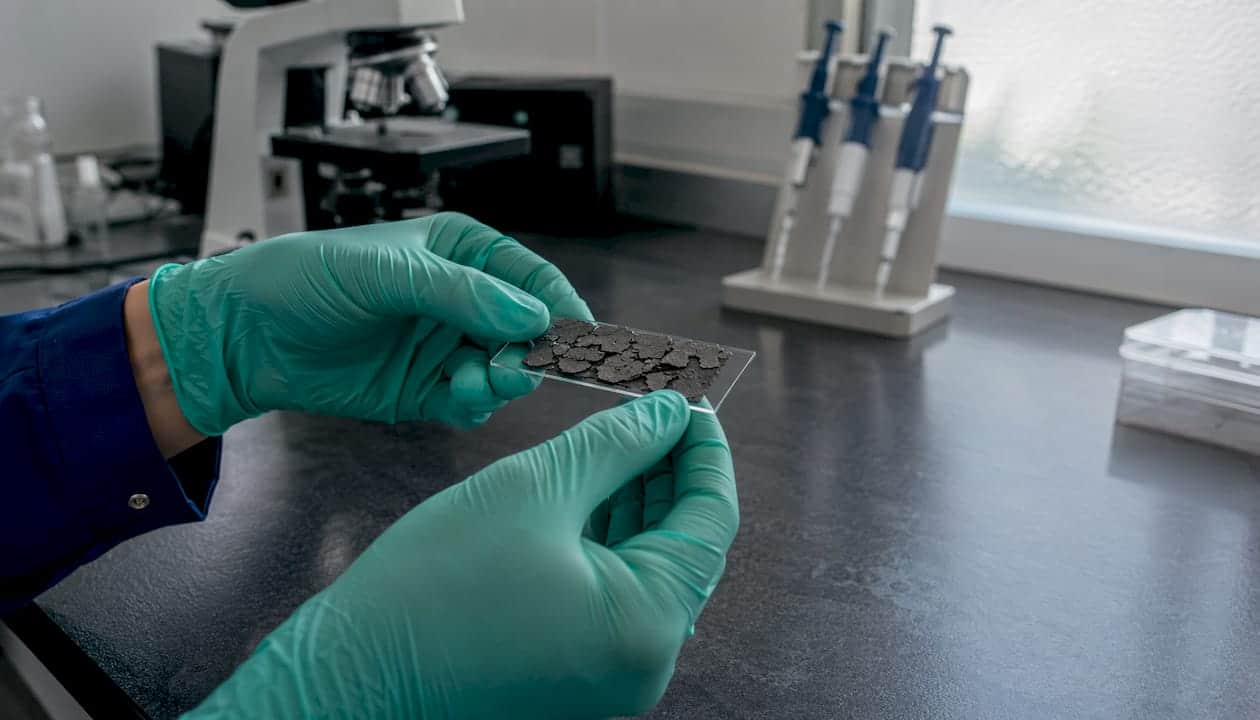
Reactive degradation: acid and alkali attack. Strong acids (sulphuric, hydrochloric) and strong alkalis (sodium hydroxide) react chemically with polymer modifiers and bitumen fractions. Laboratory studies confirm that acidic or alkaline exposure raises the softening point of SBS-modified bitumen, reduces low-temperature flexibility and degrades the styrene-butadiene-styrene modifier itself. The membrane becomes brittle, loses elongation and eventually cracks under thermal cycling.
Re-emulsification and saponification. This is the failure mode most often missed on site. Cold-applied, emulsion-based membranes contain surfactants that stabilise the emulsion during application. Once cured, those surfactants remain in the film. When standing alkaline water contacts the cured film, particularly under heat, the surfactants can re-activate and the film reverts toward a mobile phase. The result is an oil slick on ponded water, swelling and complete loss of adhesion. A field case study documents exactly this: years after installation, standing water, high alkalinity and heat combined to re-emulsify a cold fluid-applied membrane, producing visible oil slicks and bond failure. Saponification is a related but distinct reaction where ester linkages in the polymer are hydrolysed by alkali, producing soaps and glycerol-like by-products.
Oxidation and plasticiser loss. Oxidising agents such as chlorine and ozone attack double bonds in polymer chains, causing chain scission and cross-linking. PVC membranes are particularly susceptible to plasticiser migration: the plasticiser leaches out under chemical or thermal stress, leaving the membrane rigid and crack-prone. EPDM, which contains unsaturated sites in its terpolymer structure, can also oxidise, though it is generally more resistant than PVC.
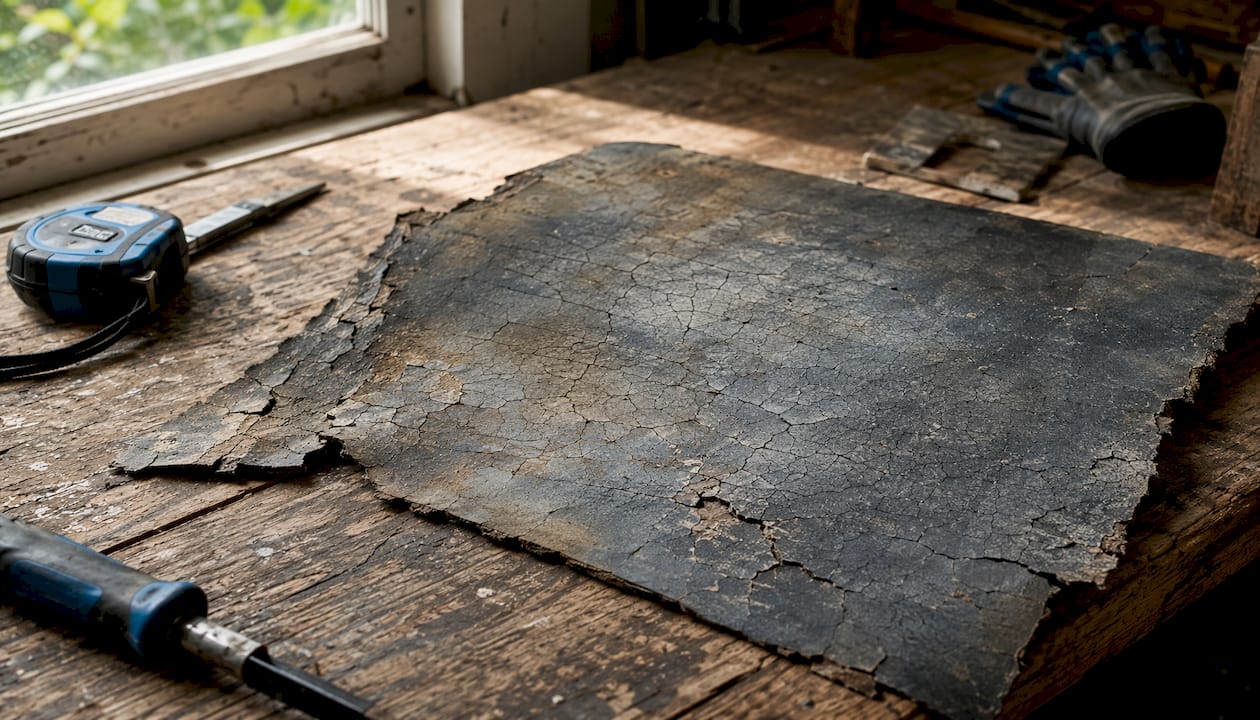
Acceleration factors. Temperature is the single biggest amplifier. Continuous immersion is far more damaging than intermittent splash. Occluded conditions, where a membrane is buried under a screed or overlay with no drainage, trap chemical species and concentrate them over time. The presence of salts or hydrocarbons in groundwater adds a secondary attack vector on top of whatever primary chemical is present.
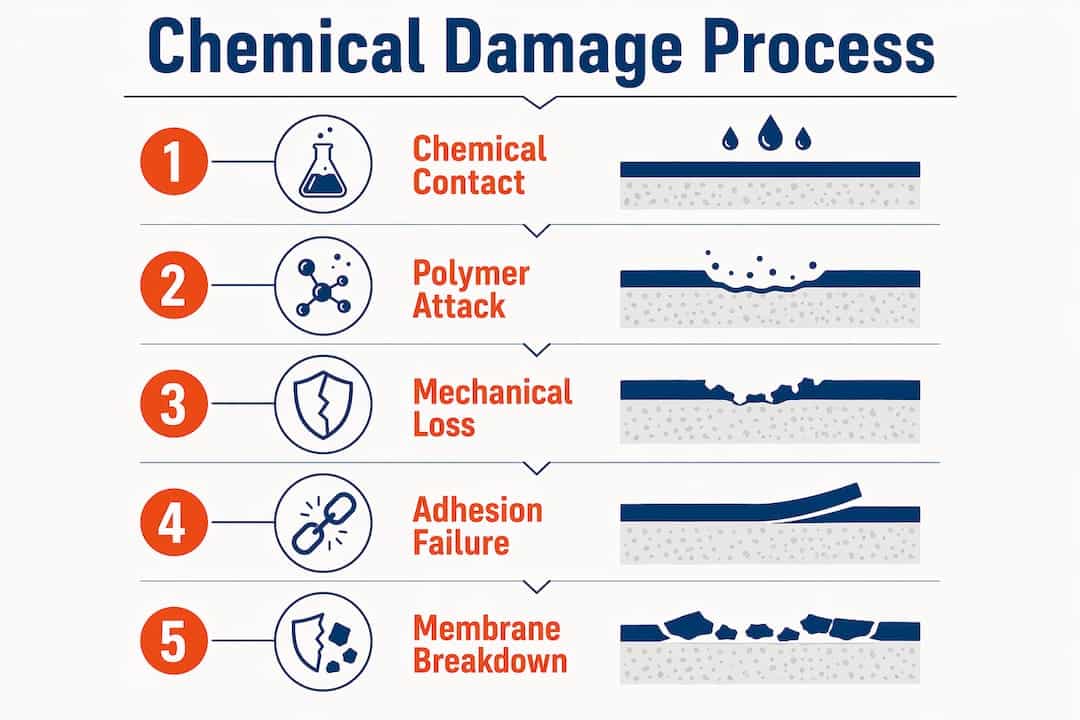
A simple way to visualise the progression: chemical contact → polymer bond attack → loss of mechanical properties → adhesion failure → leak.
Which chemical classes put your membrane at risk?
The table below maps the most common chemical classes to their typical site sources and the likely failure mode for membrane materials.
| Chemical class | Typical site source | Likely membrane effect |
|---|---|---|
| Aromatic solvents (toluene, xylene) | Plant rooms, fuel storage, contaminated fill | Swelling, dissolution, tensile loss |
| Ketones / acetone | Cleaning agents, adhesive solvents | Rapid swelling, surface softening |
| Methylene chloride | Paint strippers, industrial cleaning | Aggressive dissolution of bitumen and PU |
| Strong acids (H₂SO₄, HCl) | Battery rooms, acid drainage, industrial effluent | Polymer modifier degradation, embrittlement |
| Strong alkalis (NaOH) | Screed leachate, concrete wash, cleaning chemicals | Saponification, bond loss, re-emulsification |
| Oxidisers (chlorine, ozone) | Pool areas, water treatment, industrial vents | Chain scission, surface cracking |
| Petroleum / hydrocarbons | Fuel spills, contaminated groundwater, parking decks | Bitumen dissolution, PU swelling |
| De-icing salts / chlorides | Parking structures, coastal groundwater | Osmotic blistering, reinforcement corrosion |
| Persistent organic contaminants | Industrial brownfield sites, landfill leachate | Cumulative polymer degradation |
Concentration and duration are the deciding variables. A short splash of dilute acid on a well-cured polyurea membrane may cause no lasting damage. Continuous immersion of an SBS sheet in the same acid at elevated temperature is a different matter entirely. SBS membranes resist weak acids and many salts reasonably well, but strong acids, strong alkalis and aromatic solvents sit firmly in the danger zone. The practical lesson: never assume a membrane is safe simply because it handled a different chemical class without incident.
Battery rooms and acid drainage channels are the highest-risk environments for acid attack. Alkaline screed wash and concrete curing water are the most common source of saponification on plaza decks and podium slabs. Contaminated groundwater on brownfield sites can contain a cocktail of hydrocarbons, solvents and salts simultaneously.
How different membrane types respond to chemical exposure
No membrane is universally resistant. Each material has a characteristic vulnerability profile, and knowing it before you specify is far cheaper than finding out after installation.
-
SBS and APP modified bitumen. SBS membranes tolerate weak acids, dilute salts and mild alkalis reasonably well. Their weak points are aromatic solvents (which dissolve the bitumen fraction), strong acids and strong alkalis (which degrade the polymer modifier), and continuous immersion in any aggressive chemical. APP-modified sheets are somewhat more resistant to oxidation than SBS but share the same solvent vulnerability. Neither type should be specified in direct contact with petroleum hydrocarbons without a protective layer.
-
PVC single-ply. PVC is plasticised, which gives it flexibility but creates a long-term vulnerability: plasticisers migrate out under heat, UV and chemical stress, leaving the membrane brittle. Aromatic solvents and ketones attack PVC aggressively. Chlorinated environments (pool surrounds, water treatment) can also cause surface degradation. On the positive side, PVC performs adequately against dilute acids and alkalis when the plasticiser is retained.
-
TPO (thermoplastic polyolefin). TPO is generally more resistant to acids, alkalis and oxidisers than PVC, and it contains no plasticisers to migrate. Its vulnerability is concentrated aromatic solvents and certain ketones. TPO is a reasonable choice for mildly aggressive environments but still requires TDS verification for specific chemicals.
-
EPDM. Excellent resistance to dilute acids, alkalis, ozone and UV. EPDM struggles with petroleum-based oils and aromatic solvents, which cause swelling and softening. For a roof exposed to industrial vent emissions containing hydrocarbons, EPDM is not the right call without a protective coating.
-
Polyurethane (PU). PU membranes offer moderate chemical resistance and good crack-bridging. Methylene chloride and strong ketones attack them. Continuous immersion in strong acids or alkalis degrades the urethane linkage over time. The Sikalastic-851, a PU/polyurea hybrid available locally, is noted as having moderate chemical resistance and requires direct contact with Sika technical service for site-specific confirmation.
-
Pure polyurea. The most chemically resistant of the liquid-applied systems. Products such as Sikalastic-8440 are specified for highly acidic liquid-retaining structures precisely because of their resistance to a broad range of aggressive chemicals. Even so, manufacturers are explicit: chemical resistance is product-specific, and written technical confirmation is required for the exact chemicals present on site. Biogenic sulphuric acid (from sewage environments) is a known exception even for polyurea systems.
-
Cementitious and crystalline systems. These resist alkalis well (they are themselves alkaline) and perform adequately against dilute acids in short-term exposure. Concentrated acids dissolve the cement matrix. They are not suitable for solvent or hydrocarbon environments. Their strength is in water-bearing structures where the chemistry is broadly neutral to mildly alkaline.
The waterproofing materials guide from Prowaterproofing covers where each membrane type is typically deployed in South African conditions. The rule that applies across all materials: never rely on generic category claims. Request the product-level technical data sheet (TDS) and chemical-resistance chart for the specific formulation you are specifying.
How to detect chemical damage in the field
Catching chemical attack early requires a structured inspection, not a casual walk-over. The signs are often subtle until the membrane has already failed.
Field signs to look for:
- Soft, spongy or tacky areas when pressed with a thumb
- Swelling or raised blisters, particularly near drainage outlets or low points
- Discolouration: yellowing, darkening or a milky film on the membrane surface
- An oil-slick or iridescent sheen on standing water
- Cracking or surface embrittlement in areas not exposed to direct UV
- A solvent, chemical or sour odour at the membrane surface
- Delamination at laps, terminations or around penetrations
- Loss of elongation: a small cut sample that tears rather than stretches
Inspection checklist for site teams:
- Walk the entire membrane area systematically, marking suspect zones with chalk or tape.
- Press suspect areas with a gloved thumb. Softness or tackiness indicates solvent or alkali attack.
- Collect a sample of any standing water in a clean, sealed container. Note colour, odour and any visible sheen.
- Photograph wet and dry conditions, ponding water with sheen, edge delamination and any visible staining. Use a reference scale (a coin or ruler) in each shot.
- Cut a small sample from a suspect area and a control area away from contamination. Compare elongation by hand-stretching. Submit both to a laboratory for tensile testing and chemical analysis.
- Check drainage outlets for blockage. Blocked drains are the most common reason chemicals concentrate rather than disperse.
Safety note: Never sample liquids or membrane material without appropriate PPE. Solvents, acids and alkalis are hazardous. Nitrile gloves, safety glasses and a half-face respirator are the minimum for any site where chemical contamination is suspected. Refer to the waterproofing safety procedures guide for a full site-safety checklist before sampling.
Pro Tip: When submitting samples to a laboratory, request pH measurement, contaminant identification and a chemical-resistance immersion test at the concentration and temperature representative of site conditions. A lab report that names the chemical and its concentration gives you the evidence base to approach the manufacturer for a formal compatibility statement.
How to specify and design against chemical damage
Prevention is almost always cheaper than remediation. The decisions made at specification stage determine whether a membrane survives its service environment.
Specification actions:
- Obtain the manufacturer’s chemical-resistance chart for the specific product, not the product family.
- Request a written compatibility statement from the manufacturer’s technical service for any aggressive chemical identified during site investigation.
- Review the TDS and Safety Data Sheet (SDS) together: the TDS gives performance data, the SDS identifies hazardous components that may interact with site chemicals.
- Where exposure is uncertain, commission an independent immersion test at representative concentration and temperature before finalising the specification.
- Specify compatible primers. A primer that is chemically incompatible with site conditions can fail before the membrane is even applied.
Design controls:
- Specify a protection board or paver system over the waterproofing layer wherever foot traffic, vehicle loads or chemical spillage is possible.
- Design positive drainage gradients (minimum 1:80 on horizontal surfaces) to prevent ponding. Standing water concentrates chemical species and dramatically extends exposure duration.
- Use separation layers or sacrificial coatings in areas of known contamination risk, such as parking decks above occupied spaces or plaza slabs over podium structures.
- Detail drainage channels and outlets to prevent blockage. A blocked outlet on a plaza deck is the single most common trigger for saponification failures in South African practice.
- On brownfield or industrial sites, test site water for aggressive chemicals before finalising the membrane specification. SANS 10021 makes this a mandatory step in the design process.
Contract and quality controls:
- Include a contract clause requiring the contractor to confirm chemical compatibility of all applied products in writing before work commences.
- Set inspection hold points at substrate preparation, primer application and membrane installation stages.
- Require photographic records at each hold point, stored in the contract file.
Pro Tip: Insist on a written manufacturer sign-off, not just a verbal assurance, for any site where contaminated groundwater or aggressive cleaning chemicals are present. That document is your warranty protection if the membrane fails. Without it, the manufacturer’s warranty is almost certainly void.
What to do when chemical damage is already present
The decision between cleaning and overlay, targeted repair or full replacement depends on four things: how far the contamination has spread, whether the membrane substrate is structurally sound, whether the chemical source has been eliminated, and what the manufacturer will warrant.
Decision steps:
- Isolate and eliminate the chemical source first. Repairing a membrane while the contaminating liquid is still present is futile.
- Send a membrane sample and a water sample to a laboratory. Confirm the chemical identity, concentration and the extent of polymer degradation before committing to a repair strategy.
- Obtain a manufacturer compatibility statement for the proposed repair system. A chemically resistant overlay applied over a degraded substrate that the manufacturer has not approved will not restore warranty cover.
- Assess the extent of damage. If softening or bond loss is localised (less than 10–15% of the membrane area), targeted removal and replacement of affected sections is usually viable. If degradation is widespread, full replacement is the only defensible option.
- Document pre- and post-repair conditions with photographs and tensile test results. This record is essential for warranty claims and future inspections.
Practical repair options:
- Neutralisation and cleaning. For acid or alkali residues, neutralise the substrate (dilute sodium bicarbonate solution for acid residues; dilute acetic acid for alkali residues) and flush thoroughly before any repair work. Confirm pH is within the membrane manufacturer’s substrate requirements before applying any product.
- Targeted removal and reseal. Cut out and remove the affected membrane section to clean, sound substrate. Apply a compatible primer and new membrane section, lapping into undamaged material by the manufacturer’s minimum overlap dimension.
- Chemically resistant overlay. Where the existing membrane substrate is sound and the chemical source has been eliminated, a pure polyurea or specialist coating overlay can extend service life. This is only appropriate when the manufacturer confirms the overlay is compatible with the existing substrate and the residual chemistry. Local coating systems and case studies from South African suppliers can inform overlay selection.
- Full replacement. When polymer bonds are lost across a significant area, or when the contamination has penetrated to the substrate, replacement is the only option. Specify the replacement membrane based on the confirmed chemical environment, not the original specification.
Repair checklist for contractors:
- Isolate and confirm the chemical source is eliminated
- Submit membrane and water samples for laboratory analysis
- Obtain written manufacturer compatibility sign-off for the repair system
- Neutralise and clean the substrate; confirm pH
- Document pre-repair condition with photographs and tensile samples
- Apply repair system per TDS; photograph each stage
- Submit post-repair tensile and adhesion test results to the contract file
South African standards and what to verify before you specify
South Africa has specific standards that govern waterproofing design and installation, and they are not optional background reading. They are the framework within which specification decisions are made and warranties are defended.
Relevant SANS documents:
- SANS 10021 covers the waterproofing of buildings and is the primary reference for design, site investigation and membrane protection. It requires designers to understand water movement, test site water for aggressive chemicals and protect membranes during construction. The standard also addresses structural movement, which interacts with chemical damage by opening cracks that allow chemical ingress.
- SANS 952 covers polyolefin sheeting used in waterproofing applications and sets material and dimensional requirements relevant to TPO and similar single-ply systems.
- SANS 248 covers bituminous felt and is the reference standard for torch-applied and cold-applied bituminous membrane products.
These standards set the floor, not the ceiling. They tell you what must be done; the manufacturer’s TDS tells you what the specific product can withstand. Both are needed.
EE-AT checklist for specifiers and owners:
- Request the product TDS and SDS from the manufacturer before specification.
- Obtain the chemical-resistance chart for the specific product formulation, not the product range.
- Where site investigation identifies aggressive chemicals, request a written compatibility statement from the manufacturer’s technical service department.
- Commission an independent laboratory immersion test for any chemical not covered by the manufacturer’s standard resistance chart.
- Record all manufacturer sign-offs, lab reports and SANS compliance documents in the contract file. This is your warranty evidence if a dispute arises.
Local laboratory testing. South African accredited laboratories can test membrane samples for tensile strength, elongation and chemical resistance. When submitting samples, request: pH of the water sample, identification and concentration of contaminants, and a chemical-resistance immersion test at site-representative conditions. The South African National Accreditation System (SANAS) maintains a register of accredited test laboratories.
Pro Tip: Record site conditions that could cause trapped contamination: buried membranes under screeds, overlays with no drainage, and areas of poor fall. These are the conditions that concentrate chemicals over time and are the most common source of warranty disputes in South Africa. A photograph and a written note in the contract file cost nothing; a disputed warranty claim costs considerably more.
For a broader view of how SANS standards interact with specification decisions, the waterproofing standards guide from Prowaterproofing covers the practical application of SANS 10021, SANS 952 and SANS 248 in local projects.
Key takeaways
Chemical exposure damages waterproofing membranes through solvent dissolution, acid/alkali degradation, re-emulsification and oxidation, and the damage is preventable when the chemical environment is identified and the correct membrane is specified with manufacturer sign-off.
| Point | Details |
|---|---|
| Identify the chemical source first | Test site water for pH, contaminant identity and concentration before specifying any membrane. |
| Request product-level TDS and resistance charts | Generic category claims are not sufficient; obtain chemical-resistance data for the exact product formulation. |
| Prevent standing water | Design positive drainage gradients and clear outlets to stop chemical species concentrating on the membrane. |
| Document inspections and sign-offs | Store manufacturer compatibility letters, lab reports and SANS compliance records in the contract file. |
| Get lab confirmation before repair | Submit membrane and water samples to an accredited laboratory before committing to overlay or replacement. |
The part most specifications get wrong
The most common failure pattern Prowaterproofing encounters on South African sites is not a dramatic chemical spill. It is a plaza deck or podium slab where alkaline screed wash has been ponding against a cold-applied emulsion membrane for two or three wet seasons, and nobody noticed because the membrane looked intact from above. By the time the leak appears in the ceiling below, the membrane has re-emulsified across a significant area and the screed has to come up.
The lesson is not that emulsion membranes are bad. It is that drainage design and chemical compatibility are inseparable decisions. A membrane that is correctly specified for the chemical environment but installed over a blocked outlet will still fail. The comparing waterproofing methods article covers how drainage design interacts with membrane selection in local practice.
What I find consistently underestimated is the role of the contract document. Specifiers request TDS documents and then file them without extracting the chemical-resistance conditions into the contract clauses. The manufacturer’s written compatibility statement needs to be a contract deliverable, not a background reference. When it is, the contractor has a clear obligation to flag incompatible site chemicals before application, and the owner has a documented basis for a warranty claim if something goes wrong.
SANS 10021 gives you the framework. The manufacturer’s TDS gives you the product data. The lab report gives you the site evidence. None of the three alone is sufficient. The specifiers who avoid chemical damage failures are the ones who use all three together, record everything, and treat drainage as a first-order design decision rather than a detail to resolve on site.
Useful sources for specification and testing
- SANS 10021 (Waterproofing of buildings): the primary South African standard for design, site investigation and membrane protection. Available through the South African Bureau of Standards (SABS). Use it to confirm mandatory site investigation requirements and membrane protection obligations.
- SANS 952 (Polyolefin sheeting): material and dimensional requirements for TPO and polyolefin single-ply systems. Relevant when specifying single-ply membranes in chemically aggressive environments.
- SANS 248 (Bituminous felt): the reference standard for torch-applied and cold-applied bituminous membrane products. Use it alongside the manufacturer’s TDS to confirm material compliance.
- Manufacturer TDS and chemical-resistance charts: request these directly from the manufacturer’s technical service department for the specific product formulation. Do not rely on website summaries or product family brochures.
- Safety Data Sheets (SDS): required under South African occupational health and safety legislation. The SDS identifies hazardous components that may interact with site chemicals and sets handling and PPE requirements.
- SANAS-accredited laboratories: the South African National Accreditation System maintains a register of laboratories accredited for construction materials testing. When submitting samples, specify: pH measurement, contaminant identification, and chemical-resistance immersion testing at site-representative conditions.
- Local supplier technical resources: South African waterproofing and coatings suppliers maintain local product documentation with application limits and substrate requirements relevant to local conditions.
When you send membrane or water samples to a laboratory, include a written brief stating the suspected chemical, its approximate concentration, the site temperature range and the membrane product name and batch number. A lab report without that context is difficult to interpret and may not support a manufacturer warranty claim.
Store all manufacturer compatibility letters, lab reports, SANS compliance records and inspection photographs in a single contract file. If a dispute arises, that file is the difference between a successful warranty claim and an unrecoverable cost.