

TL;DR:
- Drainage and waterproofing systems work together to prevent water intrusion and structural damage in below-grade spaces. Proper installation of perimeter drains, French drains, and sump pumps is essential for long-term effectiveness, with regular maintenance critical to avoid failure. Accurate diagnosis of water entry points ensures repairs are targeted and durable, emphasizing the importance of professionals using advanced inspection tools.
Drainage and waterproofing solutions are systems and materials designed to control, redirect, and exclude water from a property’s foundation and below-grade spaces, preventing structural damage and moisture intrusion. The two disciplines work as a single assembly: drainage manages where water goes, while waterproofing controls whether it enters. Together, they protect basements, crawlspaces, and foundations from hydrostatic pressure that saturated soil generates against walls. Common components include perimeter drains, French drains, vapour barriers, cavity drain membranes, and sump pumps. Understanding how these elements interact is the difference between a dry property and a recurring repair bill.
What are the key components of drainage and waterproofing solutions?
Effective drainage and water management begins at the foundation perimeter. IRC 2018 R405.1 requires a perimeter drain around basement and crawl space foundations to channel groundwater away and protect walls. This is not a recommendation. It is a code requirement, and it reflects decades of evidence that foundations without perimeter drainage fail faster and more expensively than those with it.
Perimeter foundation drains
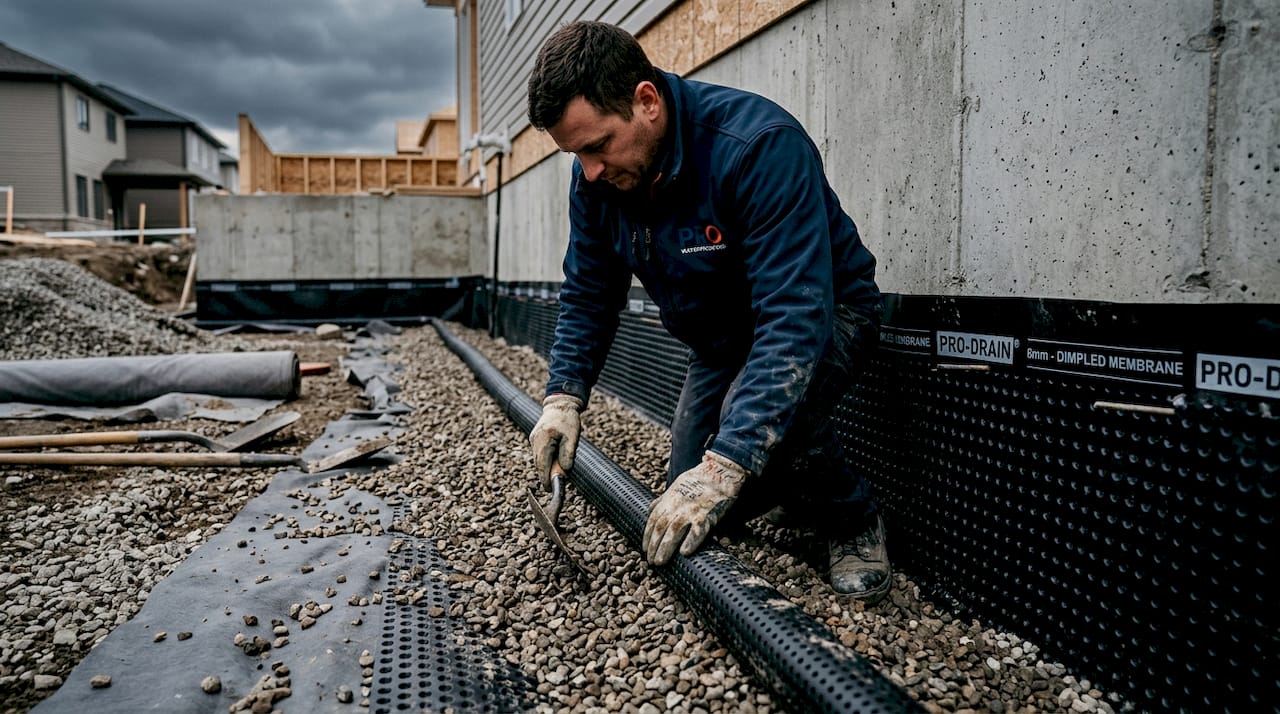
A perimeter drain is a continuous loop of perforated pipe installed at the base of the foundation footing. Correct installation requires clean gravel free of fines, a filter fabric wrap to prevent soil ingress, and a minimum pipe slope of 1/8 inch per foot toward the discharge point or sump pit. Skipping the filter fabric is one of the most common installation errors. Within a few years, fine soil particles migrate into the gravel and block the drainage path entirely.
French drains and surface drainage
A French drain operates on the same principle as a perimeter drain but is used to intercept surface water or shallow groundwater before it reaches the foundation. It consists of a trench filled with gravel and a perforated pipe, typically installed at a shallow angle across the path of water flow. French drains are particularly effective on sloped sites where surface runoff concentrates against one side of a building. They are not a substitute for foundation perimeter drains. They address a different water source and should be considered a complementary surface drainage option.
Sump pumps and gravity discharge
When a site cannot discharge drainage water by gravity, a sump pump becomes the mechanical solution. Sump pumps collect water from the perimeter drainage system in a pit and pump it away from the building. Without this component, a correctly installed drain can still flood a basement if the outlet has nowhere to go. Sump pump specifications are governed by plumbing codes adopted alongside IRC 2018 provisions, so local compliance matters.
- Perimeter drains require clean, graded gravel and filter fabric to remain effective long term.
- French drains intercept surface and shallow groundwater before it reaches the foundation.
- Sump pumps are required wherever gravity discharge to a storm drain or daylight is not achievable.
- Downspout extensions alone do not constitute a drainage system. They address roof runoff only and leave groundwater entirely unmanaged.
Pro Tip: Inspect your downspout discharge points annually. If water pools within two metres of the foundation after rain, the grade or discharge distance is insufficient, regardless of what drainage system sits below ground.
How do waterproofing methods prevent moisture intrusion in basements?
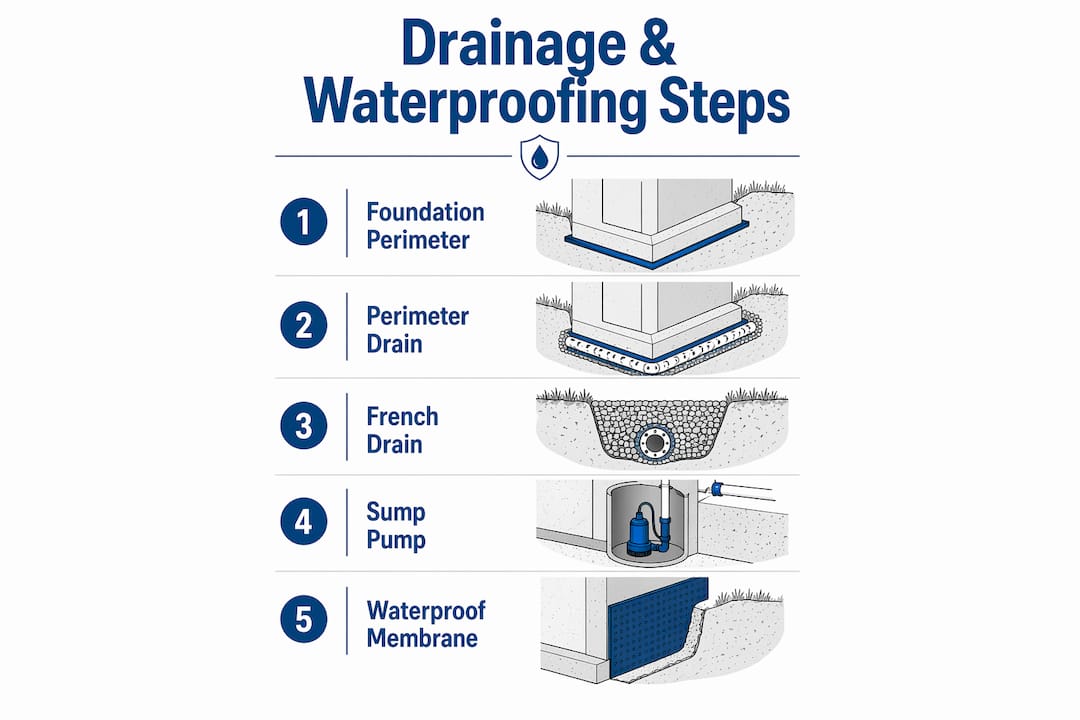
Waterproofing and dampproofing are not the same thing, and confusing them is a costly mistake. Dampproofing is a bituminous or cementitious coating applied to foundation walls to resist soil moisture under normal conditions. Waterproofing is a fully bonded or mechanically fastened membrane system designed to resist hydrostatic pressure. The distinction matters because saturated soil can generate thousands of pounds of force against a basement wall. Dampproofing is not rated for that load.
| Method | Best application | Limitation |
|---|---|---|
| Dampproofing (bituminous coat) | Dry sites with low water table | Not rated for hydrostatic pressure |
| Liquid-applied membrane | Complex geometries, irregular surfaces | Requires careful surface preparation |
| Cavity drain membrane | Retrofit and below-grade walls | Manages water ingress rather than excluding it |
| Vapour barrier encapsulation | Crawlspaces and floor slabs | Requires sealed perimeter to be effective |
| Reinforced PVC membrane (e.g., Danopol+ HS 1.2) | Terraces, buried walls, roofs | Requires thermal welding and mechanical fixing |
Vapour barriers and crawlspace encapsulation
Crawlspace moisture control integrates vapour barriers, encapsulation, and sump pumps to create a controlled dry environment that limits mould risk and protects structural timber. A vapour barrier alone, laid loosely on the ground, is not encapsulation. True encapsulation seals the floor, walls, and any penetrations with a continuous membrane, then conditions the space with a dehumidifier or ventilation system. The indoor air quality benefit is significant. Moisture rising from an unsealed crawlspace carries mould spores directly into the living areas above.
Membrane systems for below-grade walls
Reinforced membranes such as Danopol+ HS 1.2 use flexible PVC with biocides for durability against water, UV exposure, and microorganisms in buried applications. Correct installation requires mechanical fastening, thermal welding of all joints, and full compliance with European standards. A membrane that is not thermally welded at laps will leak at those joints under pressure. Cavity drain membranes take a different approach: rather than excluding water, they create a drainage void against the wall that channels any ingress to a sump. This is the preferred retrofit solution for existing basements where external excavation is not practical.
Pro Tip: When specifying a membrane for a below-grade wall, confirm whether the product is rated for permanent water contact and hydrostatic pressure. Many liquid-applied products marketed as waterproofing are only rated for intermittent moisture exposure.
What factors determine the right drainage system for your property?
No two sites have identical water behaviour, and system selection must reflect site-specific conditions. The following factors determine which combination of drainage and waterproofing is appropriate.
- Water table level. A high seasonal water table requires a full perimeter drain with sump pump, not just a membrane. Membranes without drainage relief will eventually fail under sustained hydrostatic pressure.
- Soil type and permeability. Clay soils drain slowly and hold water against foundation walls for extended periods. Sandy soils drain quickly but can shift and undermine drainage pipe installations if not properly bedded.
- Flood risk classification. FEMA guidance distinguishes between dry-proofing and wet-proofing strategies based on Base Flood Elevation thresholds. Dry-proofing seals the structure against entry; wet-proofing uses flood vents to allow controlled water entry below the Base Flood Elevation, relieving hydrostatic pressure. Applying dry-proofing below the Base Flood Elevation is a common and expensive error.
- Pre-construction survey findings. CSSW reports use thermography and core sampling to identify water entry points and recommend suitable protection types per BS 8102, including Type A (barrier), Type B (structurally integral), and Type C (drained cavity) systems. A risk register and moisture map from a CSSW survey removes guesswork from system selection.
- Access for installation. External perimeter drains require excavation to footing level. On sites with limited access, restricted budgets, or existing landscaping, an internal cavity drain system may be the only practical option, even though it is a secondary defence.
- Post-installation maintenance access. Every drainage system needs inspection access. Rodding eyes, inspection chambers, and sump pump access hatches must be designed in from the start, not added as an afterthought.
A home inspection report will often flag signs of historic water ingress, such as efflorescence, staining, or cracked render, that indicate where the current system is failing and what upgrade is needed.
What maintenance keeps drainage and waterproofing systems effective?
A correctly installed system that is never maintained will fail. The timeline varies by soil type, rainfall, and installation quality, but neglect is the most consistent cause of system failure across all property types.
- Inspect drainage outlets twice yearly. Blocked outlets cause water to back up in the drain and eventually overflow into the foundation. Clear debris from grates and rodding eyes every spring and autumn.
- Test sump pumps before the wet season. Pour water into the sump pit to confirm the float switch activates and the pump discharges correctly. A failed pump during a storm event will flood a basement within hours.
- Check for efflorescence on basement walls. White crystalline deposits on masonry indicate that water is moving through the wall and depositing minerals on the surface. This is an early warning sign, not a cosmetic issue.
- Look for mould or musty odours in crawlspaces. Mould presence in a crawlspace confirms that moisture levels are exceeding what the current vapour control system can manage.
- Verify membrane integrity after ground movement. Seismic activity, tree root growth, and soil settlement can all displace or puncture buried membranes. Any visible cracking in foundation walls warrants a professional membrane inspection.
Accurate diagnosis of water entry routes using dye tracing and thermal imaging is critical before any repair work. Patch repairs applied without identifying the actual entry point fail consistently and waste money.
Pro Tip: Schedule a professional waterproofing inspection every three to five years, even if no visible signs of failure are present. Many membrane failures begin as micro-tears or joint separations that are invisible to the untrained eye but allow progressive water ingress over years.
For further reading on protecting below-ground structures, Prowaterproofing’s guide on exterior basement wall protection covers best practices in detail. You can also review basement waterproofing techniques for a broader overview of moisture control approaches.
Key takeaways
Effective property water protection requires drainage and waterproofing to function as a single integrated system, not as separate or interchangeable fixes.
| Point | Details |
|---|---|
| Drainage precedes waterproofing | Perimeter drains must relieve hydrostatic pressure before membranes can perform as designed. |
| Dampproofing is not waterproofing | Only rated membrane systems resist sustained hydrostatic pressure from saturated soil. |
| Site conditions drive system choice | Water table level, soil type, and flood risk classification determine the correct drainage and waterproofing specification. |
| Maintenance is non-negotiable | Sump pump testing, outlet inspection, and membrane checks every three to five years prevent costly failures. |
| Diagnosis before repair | Dye tracing and thermal imaging identify actual water entry points; patch repairs without diagnosis fail repeatedly. |
Why I always start with the drain, not the membrane
After years of assessing waterproofing failures across residential and commercial properties, the pattern is almost always the same. A property owner notices seepage, a contractor applies a membrane or sealant to the interior wall, and within two seasons the problem returns. The membrane was not the issue. The drainage was.
Treating membranes as standalone solutions without addressing perimeter drainage means hydrostatic pressure continues to build against the wall. Eventually, water finds a path around or through even a well-applied membrane. The fix is not a better membrane. It is a drain that removes the pressure before it reaches the wall.
I also see a persistent belief that interior drainage systems are equivalent to external perimeter drains. They are not. Perimeter external drainage is the primary defence because it intercepts water before it contacts the wall. Interior systems collect water after it has already entered the wall assembly. That distinction matters for long-term wall integrity, not just for keeping the floor dry.
The technology available for diagnosis has improved considerably. Thermal imaging cameras can identify cold, wet zones behind plaster without any destructive opening up. Dye testing confirms whether a suspected crack is the actual entry point or a red herring. These tools make precise diagnosis possible, and precise diagnosis makes the repair last. Choosing a contractor who uses them is not a luxury. It is the minimum standard for work that will hold.
— Eben
Get professional drainage and waterproofing help from Prowaterproofing
Prowaterproofing provides expert installation of foundation drainage systems, waterproofing membranes, and crawlspace encapsulation for residential, commercial, and industrial properties across South Africa. Every project begins with a site assessment to identify water pathways, soil conditions, and the most appropriate system specification. Solutions are backed by warranty and maintenance programmes, so you are not left managing a complex system without support. DIY approaches to foundation drainage frequently miss critical installation details, such as filter fabric placement or correct pipe slope, that cause premature system failure. Contact Prowaterproofing for a professional quote and get a solution that is designed for your specific site conditions.
You can also explore Prowaterproofing’s detailed guidance on how to waterproof a basement or review the basement waterproofing steps guide before your consultation.
FAQ
What is the difference between dampproofing and waterproofing?
Dampproofing is a coating that resists soil moisture under normal dry conditions but is not rated for hydrostatic pressure. Waterproofing uses bonded or mechanically fastened membrane systems designed to resist sustained water pressure from saturated soil.
When is a sump pump required in a drainage system?
A sump pump is required when gravity discharge to a storm drain or daylight outlet is not achievable. It mechanically removes water collected by the perimeter drainage system and prevents basement flooding during high groundwater events.
How do I know if my basement waterproofing is failing?
Efflorescence (white crystalline deposits) on masonry walls, visible seepage, mould growth, and musty odours are the primary indicators of waterproofing failure. A professional inspection using thermal imaging can identify moisture behind walls before visible damage appears.
What is a French drain and where is it used?
A French drain is a gravel-filled trench with a perforated pipe that intercepts surface water or shallow groundwater before it reaches a foundation. It is most effective on sloped sites where runoff concentrates against one side of a building and complements, rather than replaces, a perimeter foundation drain.
How often should drainage and waterproofing systems be inspected?
Drainage outlets and sump pumps should be checked twice yearly, before and after the wet season. A professional waterproofing inspection is recommended every three to five years to identify membrane deterioration or drainage blockages before they cause structural damage.