
TL;DR:
- Capillary crystalline waterproofing chemically reacts inside concrete to form permanent, self-sealing crystals that block water movement. It penetrates 2 to 4 inches into the substrate, offering durable, integral protection against moisture ingress and crack sealing, unlike surface membranes. Proper surface preparation and understanding system limitations are essential for effective application in below-ground structures.
Capillary type waterproofing is defined as a crystalline technology that reacts chemically inside concrete to form insoluble crystals, permanently blocking water movement through capillary pores and micro-cracks. Unlike surface membranes, this method integrates within the concrete matrix itself, creating a self-sealing barrier that responds to new moisture ingress over time. Products such as Penetron, Crystor, and SikaControl® 1200 WT represent the leading systems in this category, each suited to different construction phases and exposure conditions. For property owners managing below-ground structures, submerged slabs, or basement walls where exterior access is impossible, capillary type waterproofing offers a fundamentally different solution to conventional membrane systems.
How does capillary crystalline waterproofing work?
Crystalline waterproofing works chemically inside concrete rather than on its surface, which is the single most important distinction to understand before selecting a waterproofing method. When water contacts the applied crystalline material, a reaction occurs between proprietary silicates and the free calcium hydroxide naturally present in concrete. This reaction produces needle-like calcium silicate hydrate crystals that grow into and fill the capillary pores, micro-cracks, and voids within the concrete substrate.
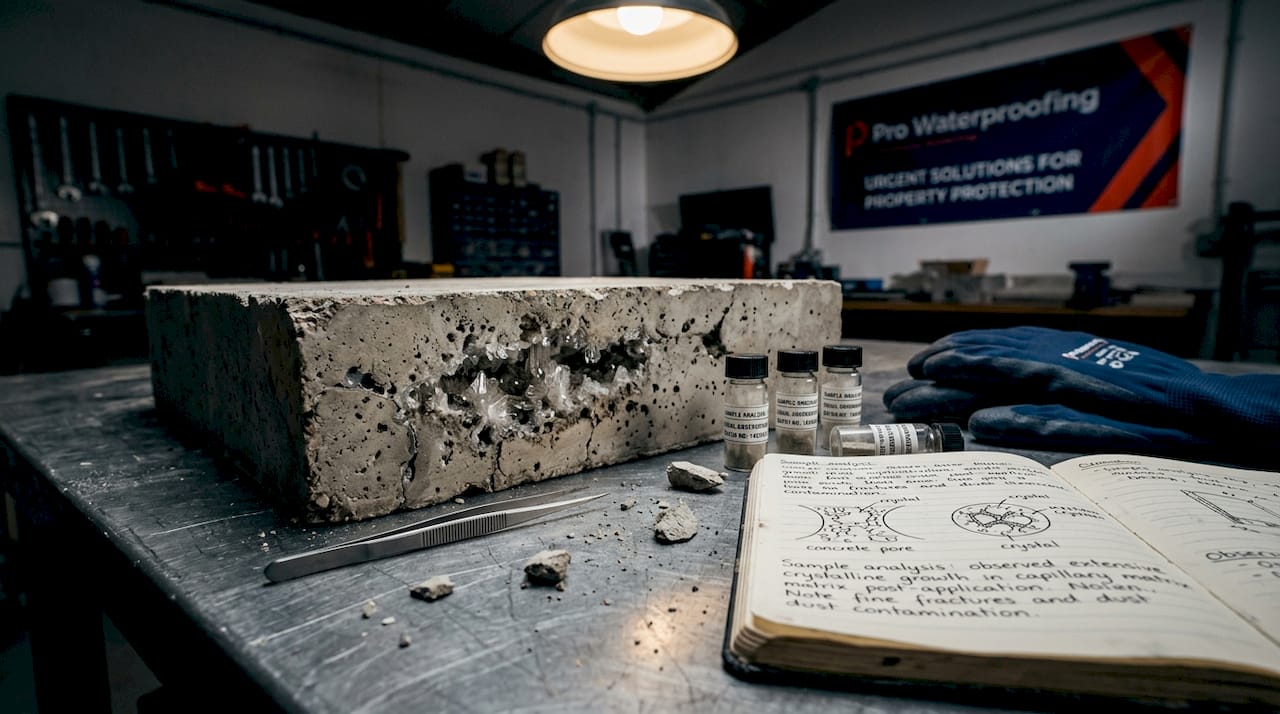
The penetration depth of this crystalline growth typically reaches 2 to 4 inches into the concrete, meaning the protection is not a film that can peel or delaminate. The crystals become a permanent part of the concrete structure. When new hairline cracks form due to thermal movement or minor settlement, residual unreacted chemicals in the concrete re-activate in the presence of moisture and generate fresh crystal growth to seal the new pathway. This self-healing behaviour is what separates crystalline systems from every other waterproofing method available.
Waterproof membranes differ from crystalline systems by relying on adhesion and elongation to bridge cracks at the surface, rather than integrating within the concrete. A membrane that loses adhesion or is punctured during backfilling loses its protective function entirely. Crystalline waterproofing carries no such risk because the protection is embedded in the substrate itself.
- Mechanism: Silicates react with calcium hydroxide to form calcium silicate hydrate crystals
- Penetration: Crystals grow 2 to 4 inches into the concrete substrate
- Self-sealing: Dormant chemicals re-activate when new cracks form and moisture is present
- Permanence: No delamination risk because the barrier is integral to the concrete
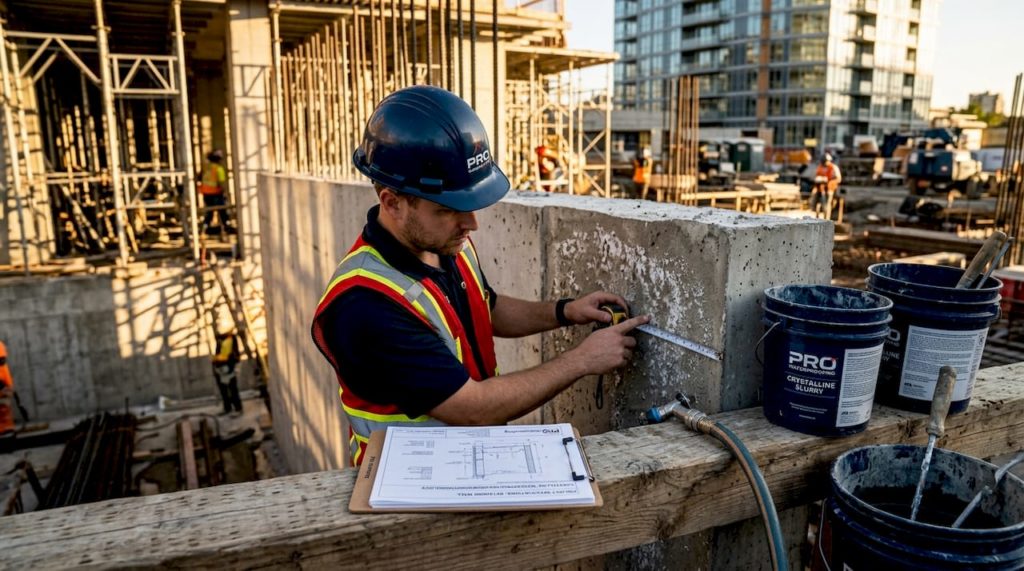
Pro Tip: Wet the concrete surface thoroughly before applying a crystalline slurry coat. The chemistry requires moisture to initiate crystal growth, and a dry substrate will absorb water from the coating before the reaction can begin properly.
Comparing capillary waterproofing methods and products
Three primary application methods exist for crystalline waterproofing, and choosing the right one depends on whether the concrete is already cured, currently being poured, or in a remedial situation.
| Method | Application timing | Typical products | Best suited for |
|---|---|---|---|
| Slurry coating | Hardened concrete | Crystor, Penetron | Remedial work, existing basements |
| Dry shake | Fresh concrete surface | Penetron Admix DS | New slabs during construction |
| Integral admixture | Mixed into fresh concrete | SikaControl® 1200 WT, Penetron Admix | New pours, tanks, foundations |
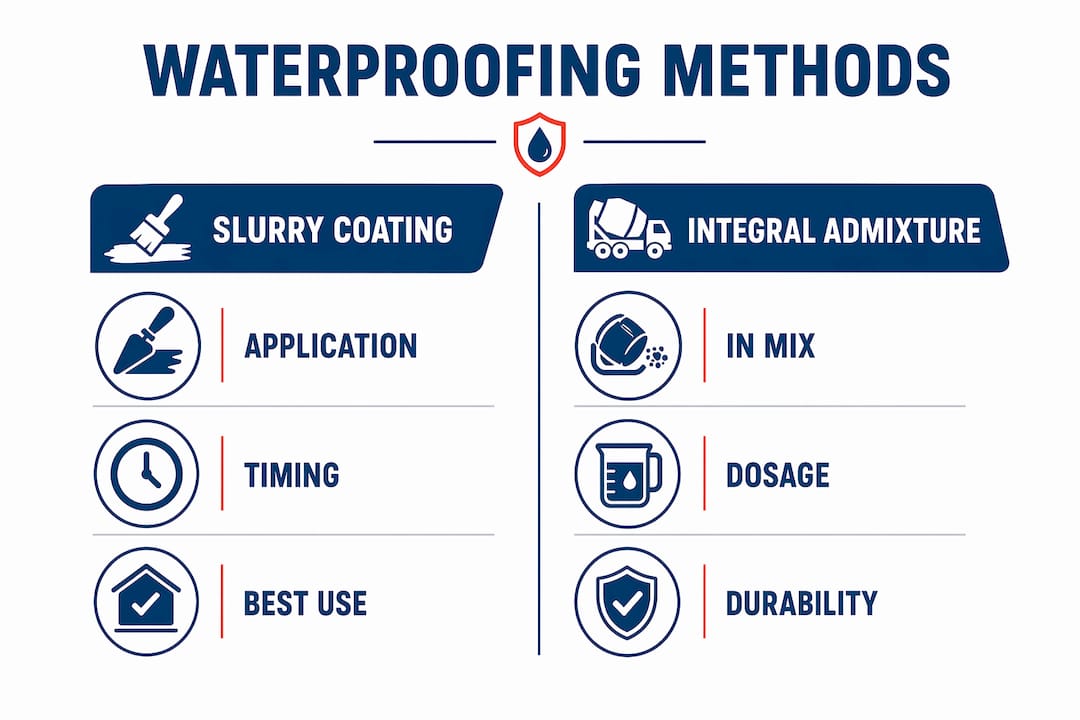
Products like Penetron, Crystor, and SikaControl® each approach the crystalline mechanism from a different delivery format, but the underlying chemistry is consistent across all three. Slurry coatings are the most common choice for existing structures because they can be applied to hardened concrete on either the positive side (water-facing) or the negative side (interior face).
Negative-side application deserves particular attention. Negative-side crystalline waterproofing is effective where exterior access is limited, working against hydrostatic pressure from the internal face of a wall or slab. This makes it the practical choice for occupied basements or retaining walls that cannot be excavated. The crystalline growth still migrates toward the water source, sealing pores from within.
Standard application rates for slurry coatings sit at approximately 1.5 lb per square yard per coat, with two coats specified for most below-grade applications. This means a 100 square metre basement wall requires roughly 3.6 kg per coat, applied in two passes with a damp cure between applications.
- Positive-side application: Applied to the exterior face before backfilling; preferred for new construction
- Negative-side application: Applied to the interior face; used for remedial work or where excavation is not possible
- Integral admixture: Mixed into the concrete batch; provides full-depth protection from the moment of pour
Pro Tip: For integral admixtures, confirm the dosage rate with the product data sheet before batching. Under-dosing reduces crystal density and compromises long-term performance, particularly under sustained hydrostatic pressure.
What are the real advantages and limitations for property owners?
The practical case for crystalline waterproofing is strongest where durability and access constraints are the primary concerns. Below-grade walls, lift pits, water-retaining structures, and tunnels all represent conditions where a surface membrane is either impractical or vulnerable to damage during construction.
The self-healing performance of cementitious capillary crystalline waterproofing has been measured at crack-closure ratios exceeding 80% under seawater immersion and dry-wet cycling conditions. Specifically, studies report 82.90% crack closure under seawater and 87.56% under dry-wet cycles. These figures confirm that the self-sealing mechanism is not a theoretical claim but a measurable, reproducible outcome under realistic environmental conditions.
The limitations are equally worth understanding before committing to a crystalline system. Crystalline waterproofing does not bridge structural cracks or accommodate significant movement. A crack wider than approximately 0.4 mm typically exceeds the self-sealing capacity of the crystal growth, and active structural movement will continue to open new pathways faster than the chemistry can respond. In these situations, a flexible membrane or an injection repair must address the structural crack before crystalline treatment is applied.
Capillary moisture problems usually arise from construction interface failures at joints, penetrations, and cracks beyond the system’s capacity, not from chemistry failure alone. Surface preparation is therefore not optional. Concrete must be clean, sound, and free of curing compounds, oils, or laitance that would prevent the crystalline material from bonding and penetrating. A poorly prepared substrate is the most common reason crystalline waterproofing underperforms in practice.
For below-grade waterproofing in residential and commercial properties, the most reliable outcomes come from combining crystalline treatment with complementary drainage or membrane systems where ground conditions are severe. Crystalline waterproofing is not a single-solution answer to every moisture problem, but it is the most durable primary barrier available for concrete structures.
Application standards and best practices for below-ground structures
Implementing crystalline waterproofing correctly requires understanding both the technical requirements of the product and the regulatory framework governing below-ground construction.
BS 8102:2022 is the governing British standard for the protection of below-ground structures against water ingress, and it distinguishes waterproofing from dampproofing as a critical design decision. Dampproofing resists non-pressurised moisture; waterproofing resists hydrostatic pressure from saturated soils. Crystalline capillary systems qualify as waterproofing under this distinction, making them appropriate for Grade 2 and Grade 3 environments where dry conditions are required.
The following sequence represents best practice for applying crystalline waterproofing to an existing below-grade concrete structure:
- Assess the substrate. Test for structural cracks, active leaks, and surface contamination. Repair any crack wider than 0.4 mm with a polyurethane injection or hydraulic cement before proceeding.
- Prepare the surface. Mechanically abrade or acid-etch the concrete to open the surface pores. Remove all laitance, curing compounds, and surface coatings.
- Pre-wet the substrate. Saturate the surface with clean water until the concrete is saturated surface dry (SSD). This is non-negotiable for crystal formation.
- Apply the first coat. Brush or spray the crystalline slurry at the specified rate (typically 1.5 lb per square yard). Work into corners and construction joints with particular care.
- Cure and apply the second coat. Keep the first coat damp for 48 hours, then apply the second coat in the opposite direction to the first for uniform coverage.
- Protect and monitor. Prevent rapid drying, frost, and direct sunlight during the curing period. Inspect after 28 days for any areas of incomplete coverage.
Combining crystalline treatment with a cementitious waterproofing layer or a cavity drain membrane is best practice for structures subject to high hydrostatic pressure or where the concrete quality is variable. The integration of crystalline waterproofing with membranes and drainage is recognised as the most reliable approach for complex moisture ingress scenarios.
| Scenario | Recommended approach | Notes |
|---|---|---|
| New basement slab | Integral admixture plus positive-side slurry | Apply slurry before backfilling |
| Existing basement wall | Negative-side slurry coating | Two coats at 1.5 lb/sq yd each |
| Water-retaining structure | Integral admixture | Full-depth protection from pour |
| High hydrostatic pressure | Crystalline plus cavity drain membrane | Dual-system for redundancy |
For South African properties, the same principles apply. Ground conditions in coastal and high-rainfall regions create sustained hydrostatic pressure that demands waterproofing rather than dampproofing, and crystalline systems are well-suited to the concrete construction methods common in local residential and commercial building.
Key takeaways
Capillary type waterproofing is the most durable concrete moisture barrier available because it integrates within the substrate, self-seals new micro-cracks, and cannot delaminate or peel under hydrostatic pressure.
| Point | Details |
|---|---|
| Mechanism is chemical, not physical | Crystals form inside concrete pores, not on the surface, providing permanent protection. |
| Self-sealing is measurable | Crack-closure ratios exceed 80% under seawater and dry-wet cycling conditions. |
| Three application methods exist | Slurry, dry shake, and integral admixture suit different construction phases and access conditions. |
| Limitations are real | Structural cracks wider than 0.4 mm and active movement exceed the system’s self-sealing capacity. |
| Surface preparation is critical | Poor substrate preparation is the leading cause of underperformance in crystalline waterproofing projects. |
Why I think most property owners underestimate this technology
Most of the moisture problems I see in below-grade structures come down to one of two things: the wrong product was chosen, or the right product was applied to an unprepared surface. Crystalline waterproofing sits in an unusual position because it genuinely does what it claims, yet it is consistently misunderstood as just another coating.
The self-healing aspect is the part that surprises property owners most. Concrete moves. It always will. A system that responds to new cracks by generating fresh crystal growth is not a marketing claim; the science behind it is well-documented and the performance data is reproducible. What I find frustrating is that contractors sometimes sell crystalline systems as a universal fix, which they are not. They will not bridge a 2 mm structural crack. They will not compensate for concrete that was poorly mixed or inadequately cured.
My honest advice is this: use crystalline waterproofing as your primary barrier for concrete structures, but design the system with its limitations in mind from the start. Pair it with a drainage layer where ground pressure is high, and address structural cracks separately before application. The drawbacks of negative-side waterproofing are worth reading before you commit to an interior-only treatment, particularly if the structure has active water ingress. A good contractor will assess the full picture rather than defaulting to a single product. That is the standard you should hold them to.
— Eben
Prowaterproofing’s crystalline waterproofing solutions
Prowaterproofing specialises in crystalline and cementitious waterproofing solutions for residential, commercial, and industrial properties across South Africa. Whether you need a negative-side slurry treatment for an existing basement, an integral admixture specified for a new concrete pour, or a dual-system approach combining crystalline protection with cavity drainage, the team at Prowaterproofing applies the correct method to your specific structure and ground conditions. Every project is assessed against current waterproofing standards to confirm the solution matches the hydrostatic pressure and moisture exposure your property faces. Contact Prowaterproofing for a site assessment and tailored recommendation before your next waterproofing project.
FAQ
What is capillary type waterproofing?
Capillary type waterproofing is the common descriptive term for crystalline waterproofing, a system in which proprietary silicates react with free calcium hydroxide inside concrete to form insoluble crystals that permanently block capillary pores and micro-cracks. The result is a self-sealing, integral barrier that cannot peel or delaminate.
How deep does crystalline waterproofing penetrate into concrete?
Crystalline waterproofing penetrates 2 to 4 inches into the concrete substrate, forming crystals throughout that depth rather than only at the surface. This depth of penetration is what gives the system its durability advantage over surface-applied membranes.
Can crystalline waterproofing be applied from the inside of a building?
Yes. Negative-side application is a recognised method for situations where exterior access is not possible, such as occupied basements or retaining walls that cannot be excavated. The crystalline growth migrates toward the moisture source and seals pores from within.
What are the main limitations of capillary crystalline waterproofing?
Crystalline waterproofing cannot bridge structural cracks wider than approximately 0.4 mm or accommodate ongoing structural movement. Active cracks must be repaired with polyurethane injection or hydraulic cement before crystalline treatment is applied, and the concrete substrate must be properly prepared for the chemistry to work effectively.
How does crystalline waterproofing compare to a membrane system?
Membrane systems rely on adhesion and surface continuity to block water, while crystalline systems integrate chemically within the concrete matrix. Membranes can delaminate or be punctured during backfilling; crystalline barriers cannot, because the protection is part of the concrete itself. For complex or high-pressure situations, combining both systems delivers the most reliable outcome.